Merge toward a connected frontier, not toward the biggest visible group.
Which connected group keeps the next equal tile reachable?
This constructed ledger treats equal tiles as abstract values; refill and scoring formulas remain source-limited.
| Move | Connected result | Frontier change | Risk |
|---|---|---|---|
| Join two equal tiles | Small confirmed group | Opens adjacent cells | Good if equal neighbors remain |
| Wait for a third equal tile | Larger potential group | May delay refill | Poor if the board blocks connection |
| Merge away from frontier | Isolated value | Reduces reachable neighbors | Harder to continue |
A useful merge keeps the next equal tile within connected reach.
First bad decision
Grow a group away from the area where new equal tiles are likely to arrive.
- Tempting move
- Grow a group away from the area where new equal tiles are likely to arrive.
- Why it appeals
- The current group becomes larger.
- Actual cost
- The next tile may have no connected path to it.
Before the next decision
Merge number up: the four-point re-check
- Mark likely arrival zones.
- Keep groups connected to open cells.
- Avoid merging into a corner.
- Compare group size against future reachability.
Merge number up’s opening screen
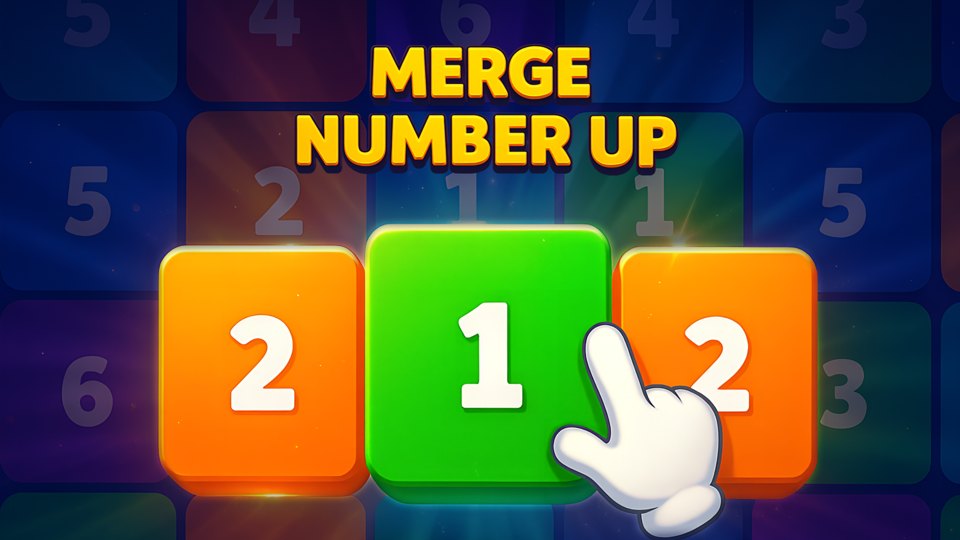
The tested game took several seconds to move from a black loading frame to a visible tutorial. The final stable screen showed a portrait number grid with a highlighted row reading 2, 1, 2. The instruction says to select the middle node to increase the value, and a hand points to the green 1. Score, level, coin, pause, and four helper buttons are visible around the board.
That wait is worth recording: a screenshot taken too early would have been a black frame rather than evidence of the game. Our retained image captures the actual tutorial after loading completed.
Shape left behind is the real score
Tap two or more connected equal-number tiles to merge them into a higher-valued tile; new tiles then fall from the top to fill the gaps, according to the current listing.
It says larger groups score more, but does not specify a numeric scoring formula or the exact cell in which the merged tile remains.
How post-merge gaps shape the board
The highlighted example suggests that selecting a middle value between matching numbers can raise it and create a merge. The broader board contains many adjacent values, so the player must identify a move that forms or extends a valid chain rather than tapping the largest number.
Each merge changes nearby opportunities. The useful question is whether an increase creates another match immediately or leaves a high value isolated.
Start with the tutorial's local pattern and observe exactly how the three cells transform. Then search for the same relationship elsewhere. Favor a move that produces a follow-up chain in the same region.
The board is compact enough to scan in sections. Check rows first, then columns, then any diagonal rule only if the tutorial demonstrates it.
The tutorial uses direct tap or click selection. The numbered cells remain the primary cue even though each value also has a color, which is helpful for players who cannot depend on hue alone. Keyboard navigation was not demonstrated.
The portrait board uses only part of a wide desktop screen, but its digits were readable. On a phone, helper buttons and the coin price below them may become tighter. We did not test orientation changes, zoom, undo behavior, or alternative input.
The Playgama source showed a pre-roll, and the initial game load briefly appeared completely black. Readers should wait before concluding the build is broken. Four bottom helpers show coin prices, indicating an in-game resource economy. We did not purchase or activate any helper.
The progression could become repetitive if later levels merely add larger numbers without new spatial constraints. Our first-session evidence cannot judge long-term variety.
This game is a good candidate for players who like compact arithmetic patterns, chain reactions, and clear tutorial examples. Readers wanting fast action or keyboard documentation should look elsewhere. The main test is whether each merge creates a readable new decision.
Playgama supplies the build. znvrgames waited through loading, inspected the tutorial on August 31, 2026, and wrote this independent guide. Ads, helper prices, rules, and availability may change at the source.
The black loading interval should be measured again on a cold browser session and on mobile data, because a slow start can look like a broken game. A longer review should complete the tutorial, confirm every allowed neighbor direction, and document what each coin-priced helper actually does. It should also verify whether coins are earned at a reasonable rate without ads or purchases. Until then, we describe the observed interface but do not grade its economy.
The highlighted 2–1–2 row is useful because it reveals that the middle value can be changed to create a relationship with its neighbors. The correct lesson is not merely “tap the green node”; it is to compare the board before and after that tap. Watch whether the 1 becomes 2, whether equal values merge automatically, and where the resulting value lands. Each outcome leads to a different planning rule for later chains.
Before using a helper, scan for moves that create two consequences instead of one—for example, increasing a center value that connects matching numbers on both sides. Preserve open cells around large values until the direction of merging is clear. A future session should also test a deliberately unhelpful selection and note whether it is blocked, reversible, or simply consumes a turn. That small experiment would establish how forgiving the puzzle is and whether the visible score rewards efficient chains or only total merges.
Do not plan through an unknown refill
Imagine a group of three 2s beside a separate pair of 4s. Merging the 2s will remove cells, leave a higher-valued tile, and trigger falling replacements.
You can plan the currently legal group, but you cannot guarantee a later 4-to-4 connection without knowing the result’s location, gravity, and incoming tiles. Treat that continuation as conditional. Compare what each available merge preserves on the visible board, then reread the board after the refill. This is different from assuming that the largest immediate group must produce the best future shape.
The example does not assume a 2048-style doubling rule; the source only says the result has a higher number.
Keep high values near supporting neighbors.
- Sketch the post-merge shape.
- Keep high values near supporting neighbors.
- Avoid filling both escape routes.
Sketch the post-merge shape.
- Sketch the post-merge shape.
- Keep high values near supporting neighbors.
- Avoid filling both escape routes.
- Prefer merges that centralize future options.
A merge opens a large gap
A merge opens a large gap
Judge whether the gap connects or fragments the board.
A higher number can create an inaccessible island.
Two equal groups exist
Choose the merge that preserves adjacency for the next chain.
Immediate value is not the only return.
Suits number-merge players who care about spatial consequences.
Suits number-merge players who care about spatial consequences.
Less ideal for pure arithmetic speed.
Merge number up versus block blast jewel puzzle
Block Blast uses shape placement and line clears; Merge number up combines connected equal values and refills from above. Counting empty cells helps neither unless the next-state transformation is also applied.
Read the comparison overview →A thoughtful merge puzzle when you evaluate shape after value.
A thoughtful merge puzzle when you evaluate shape after value.
Editorial synthesis: Do not plan through an unknown refill
Merge Number Up is best evaluated by its refill uncertainty. A merge can look profitable while consuming the only open space needed for the next number, and a player cannot plan responsibly through a refill rule that has not been observed. The article therefore separates what the visible board permits from what the source merely implies. That is useful to readers because it tells them when to stop calculating and start checking the live behavior. The game will suit players who enjoy arithmetic choices under spatial pressure, provided the refill behavior feels learnable rather than arbitrary.