Plan merges on faces, not just rows.
Which face still has room for the next equal cube?
This cube-face model separates visible row, hidden face, and rotation consequence; exact 3D rules remain source-limited.
A merge is safer when the receiving face also has an escape route for the next equal value.
First bad decision
Complete a face merge that seals the only open adjacent face.
- Tempting move
- Complete a face merge that seals the only open adjacent face.
- Why it appeals
- The visible layer becomes cleaner.
- Actual cost
- The next equal cube may have nowhere useful to connect.
Before the next decision
2048 3D: Merge Cubes: the four-point re-check
- Inventory all exposed faces.
- Separate visible row from hidden face.
- Preserve one adjacent open destination.
- Rotate only to expose a planned merge.
2048 3D: Merge Cubes’s opening screen
The live build opened to a pale blue full-screen menu after we closed the source advertisement. Four large controls were visible: Levels, Endless mode, Store, and Settings. That layout shows the game is not limited to a single endless score run. It offers a staged route as well as an open-ended mode, although we did not inspect every level or item in the store.
The menu was stable and readable in a desktop browser. No znvrgames navigation or advertising was present in the inspected image because the provider build was opened directly for private research. This article does not embed that provider environment or expose a Play control.
Arithmetic plus physical landing zones
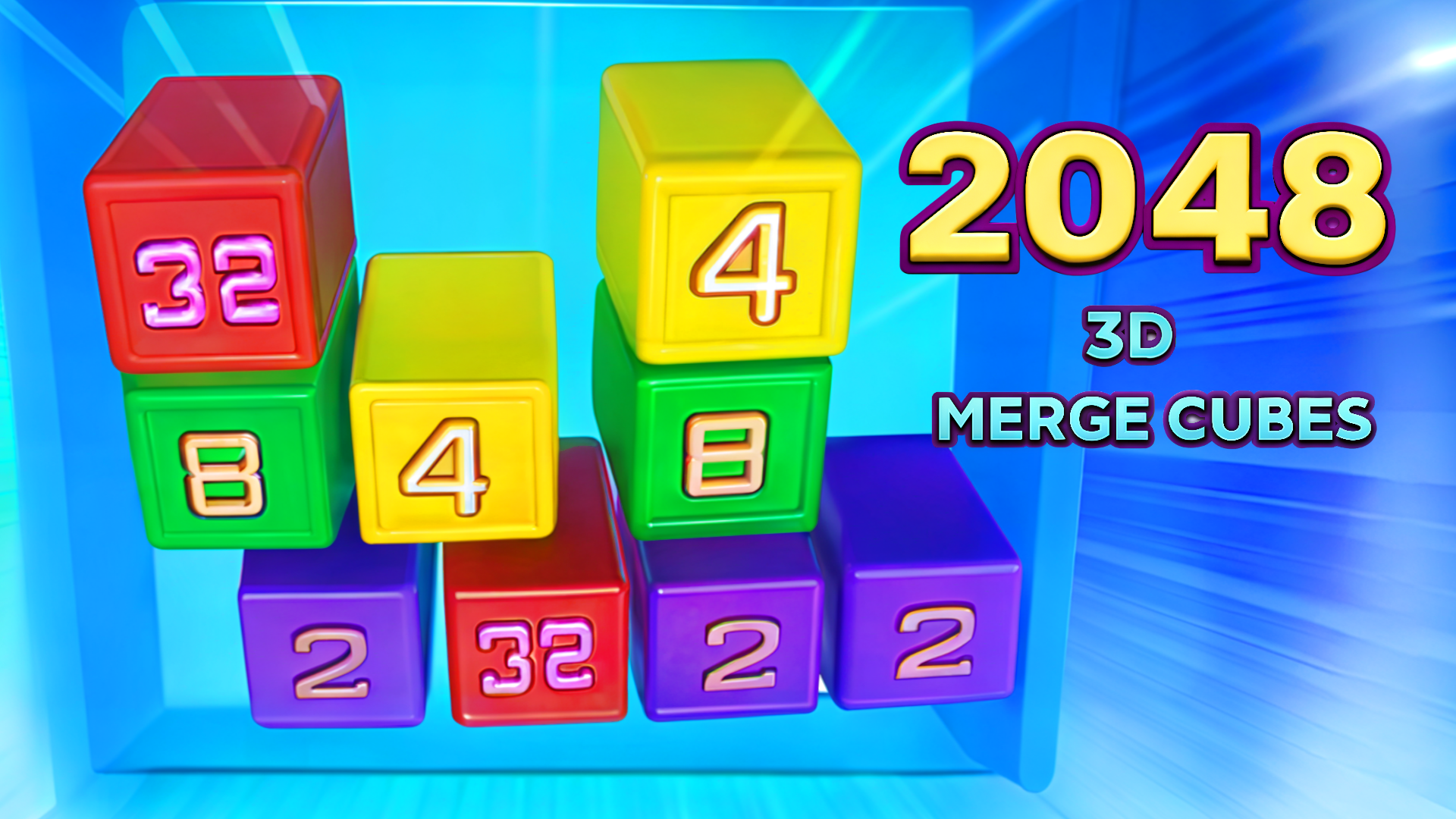
Numbered cubes from 2 to 2048 drop and matching values combine.
Stone blocks cannot merge; boosters include X2, bomb, and flash.
A block above the boundary for more than three seconds ends the run.
How drop zones protect cube chains
The familiar 2048 idea is translated into a three-dimensional container. Numbered cubes are launched or dropped into the play area. When matching values meet, they combine into a higher number. The extra dimension matters: cubes can roll, stack, block a lane, or nudge another piece away from the intended contact.
Success therefore depends on both arithmetic grouping and physical placement. It is not enough to know that two 16s should meet. The player also needs a route that keeps them accessible rather than buried under unrelated values.
Use Levels first if you want to learn one constraint at a time; choose Endless mode only if you already understand the launch behavior. Keep the largest values toward a stable side or back area, then feed smaller matches toward them. Constantly changing the preferred side creates a scattered container with no clean merge chain.
When a launch lands badly, adapt the next aim rather than forcing the original pattern. The physics may turn an imperfect placement into a useful ramp or barrier.
The tested menu uses large pointer-friendly buttons. The playfield itself is expected to rely on aiming and release gestures, making mouse or touch the most plausible inputs; the opening screen did not establish keyboard support. Values need to remain readable while cubes overlap, so a larger display may be more comfortable during crowded late states.
Players sensitive to motion should expect rolling and collision effects rather than a static grid. We did not verify camera settings, reduced-motion options, or color-independent markings beyond the visible numbers.
The source player displayed a third-party ad before the menu. The menu also includes a Store, which signals an in-game commercial area, but we did not open it, purchase anything, or test rewarded continues. Those untested elements should not be described as harmless or mandatory without evidence.
Physics can introduce its own frustration. A correct numerical plan may fail because a cube bounces or wedges unexpectedly. That unpredictability is the main difference from a traditional grid-based 2048 board.
This is a reasonable choice for players who enjoy merge chains but want a more tactile, less deterministic variation. Perfect-information strategy, minimal animation, and commercial-free play are poorer matches. Levels should suit short goal-oriented sessions; Endless mode is the clearer option for score chasing.
Playgama supplies the live game. znvrgames provides an independent first-session guide and does not claim to be its developer. The review reflects the source state observed on August 31, 2026. Ads, modes, physics, store contents, and availability can change after that date.
Stone blocks shape the merge route
High cubes are separated: Feed smaller matches toward one stable region. A chain needs reachable neighbors.. Stones block a lane: Use a bomb only when it restores a needed route. Boosters are resources, not reflex buttons..
Leave drop space in front of high values.
- Keep the largest chain on one side.
- Leave drop space in front of high values.
- Watch bounce before precision drops.
Keep the largest chain on one side.
- Keep the largest chain on one side.
- Leave drop space in front of high values.
- Watch bounce before precision drops.
- Clear boundary threats before score chasing.
High cubes are separated
High cubes are separated
Feed smaller matches toward one stable region.
A chain needs reachable neighbors.
Stones block a lane
Use a bomb only when it restores a needed route.
Boosters are resources, not reflex buttons.
Great for readers who want tactile 2048 variation.
Great for readers who want tactile 2048 variation.
Less suitable if unpredictable physics feels unfair.
2048 3D: Merge Cubes versus merge number up
The cube listing makes gravity and boundary timeout immediate: matching values combine as pieces land, while stones and boosters change a dropping board. Merge number up describes connected equal tiles chosen after placement, then refills; its source leaves score formula and landing cell open.
Read the comparison overview →A 3D merge puzzle with real lane-management decisions.
A 3D merge puzzle with real lane-management decisions.
Editorial synthesis: Arithmetic plus physical landing zones
The three-dimensional version changes the meaning of a merge. In a flat grid, a matching pair occupies a predictable cell; here the landing zone, bounce, and stack can decide whether the arithmetic plan survives. The article's independent value is its two-layer test: first choose a numerical merge, then protect the physical space needed to complete it. That explains why the title may appeal to players who want tactile uncertainty and frustrate players who prefer deterministic 2048 planning.