Release the pin whose dependency list is already empty.
Which pin is free only after another releases its load?
This dependency model labels obstruction order without asserting a captured level.
- Pin ANo listed dependency; candidate first pull
- Pin BHeld by A’s strap
- Pin CSupports the path needed after B
- Pin DOnly becomes readable once C opens
A legal-looking pull is useful only when no upstream obstruction still controls it.
First bad decision
Pull the pin closest to the reward while its strap still supports a blocker.
- Tempting move
- Pull the pin closest to the reward while its strap still supports a blocker.
- Why it appeals
- It points toward the objective.
- Actual cost
- The dependent obstruction may close the route before it opens.
Before the next decision
Hook Pin Jam: the four-point re-check
- Name what holds each pin.
- Start with an empty dependency list.
- Predict the next obstruction after release.
- Retrace the chain after every opening.
Hook Pin Jam’s opening screen
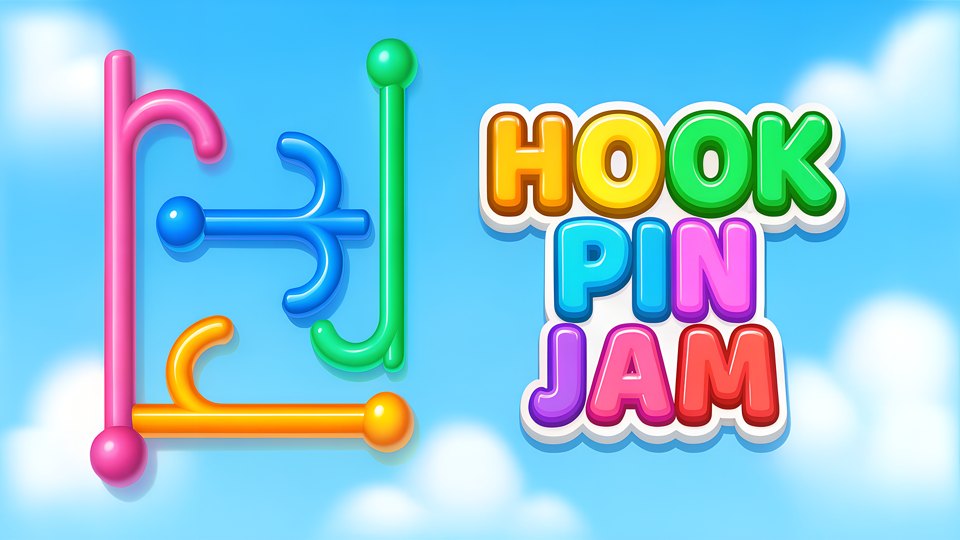
The source build loaded straight into Level 1 after the pre-roll was closed. A purple U-shaped hook occupied the center of a white screen, and a hand marker indicated the lower-left endpoint. Settings, restart, and an orange next or ad-marked control were visible around the edges. This retained screenshot is separate from the public promotional cover.
The sparse screen confirms that the game teaches interaction one object at a time. It does not establish how crowded later boards become or how often the ad-marked control is required.
Follow an obstruction chain to its free end
Assume an illustrative tangle where A cannot leave until B is removed, B is blocked by C, and C has a clear release direction.
The dependency order is C, B, A. Tapping A repeatedly cannot help while B remains in its way. If both C and D are free, compare what each release unlocks rather than only choosing the nearest hook. Because the source mentions limited lives, a visual guess may have a cost; a dependency map makes the reason for a move explicit without pretending to know the life penalty for an invalid tap.
The dependency example assumes its stated release directions. A crossing in artwork alone does not prove a physical collision in this game.
How obstruction chains hide the first pull
Hook Pin Jam is about removing or moving interlocked hooks in a safe order. A piece may look free at one end while its curve still traps another object. The puzzle asks the player to recognize which hook can travel without crossing a blocked path.
As complexity grows, endpoint position, rotation direction, and available empty space should matter more than color alone. The problem is closer to untangling hardware than matching identical pieces.
Start from the outermost hooks. Trace each shape from one ball end through the bend to the other end, noting every intersection. A hook with a clear exit path is a better first move than one surrounded by empty-looking space but physically linked through its curve.
In a dense board, mentally classify a piece as free, dependent, or uncertain. Test the free group first and revisit uncertain hooks when the geometry changes.
The tutorial hand implies drag or tap input. The large central object and empty background make the first instruction easy to see with mouse or touch. No keyboard legend appeared, so keyboard-only play is unverified.
The game relies on shape outlines and color gradients. Players with low vision may find thin crossing points harder to distinguish on a small screen. We did not find zoom, high-contrast, or alternative input settings during the initial inspection.
The exported source displayed an advertisement before launch. An upper-right control includes a small video-ad symbol, which likely offers a skip, hint, or forward action in exchange for an ad; we did not press it. The green restart button appears available separately.
Later puzzles could become frustrating if drag paths are narrow or collision rules are not visually obvious. Our session did not test hints, move limits, purchases, or whether every level has a no-ad solution.
This title fits players who enjoy spatial untangling, clean one-screen puzzles, and discovering a dependency order. It will be less comfortable for users who need keyboard support, dislike optional-ad hints, or prefer numerical logic. A useful first-session test is whether the game clearly explains why a hook is blocked.
The useful habit is to identify freedom before moving anything. Trace each hook from its curved body to both endpoints, then ask which endpoint can travel without crossing another piece. A move that creates a larger open region is normally more valuable than one that only shifts a hook to a different crowded edge. On later boards, it should also help to distinguish the hook that is physically blocked from the hook that merely looks close to another line; the collision response, not visual proximity alone, decides the order.
When a drag fails, release it and use restart rather than repeatedly forcing the same narrow path. Repeated attempts can hide whether the problem is route choice or pointer accuracy. A responsible deeper test would solve several boards without the ad-marked control, document whether hooks may rotate as well as translate, and compare a mouse drag with touch input. It would also record what the video symbol actually offers. Until then, the first tutorial proves a direct manipulation puzzle with dependency ordering, but not the fairness of its later geometry or hint system.
Remove the obstruction, not the nearest hook
The current instructions say to tap hooks to release them, clear the tangle, and aim for fewer moves.
The listing mentions a limited lives system and in-game rewards. It does not establish the exact collision test, hook-release direction, or current way lives are replenished.
Follow each hook’s path before pulling.
- Follow each hook’s path before pulling.
- Find the piece with no upstream obstruction.
- Avoid releases that cross a remaining path.
- Redraw dependencies after each removal.
A hook looks immediately free
A hook looks immediately free
Trace whether another hook passes through its sweep.
Visual freedom is not structural freedom.
Two hooks appear mutual
Look for the third dependency that starts the chain.
Mutual-looking jams usually have an external key.
Find the piece with no upstream obstruction.
- Follow each hook’s path before pulling.
- Find the piece with no upstream obstruction.
- Avoid releases that cross a remaining path.
Suits methodical untangling and short causal puzzles.
Suits methodical untangling and short causal puzzles.
Poor fit if ambiguous collision rules bother you.
Hook Pin Jam versus car escape parking
Both invite a blocker-first plan. Parking describes forward/backward lanes explicitly; Hook Pin Jam’s written source leaves the release geometry less precise. Avoid treating a visible crossing as a fully specified movement rule.
Read the comparison overview →A dependency-chain puzzle for patient readers.
A dependency-chain puzzle for patient readers.
Editorial synthesis: Follow an obstruction chain to its free end
The page's original contribution is a way to read obstruction chains without guessing at the whole board. Start with the free end of a chain, identify the pin or hook that is physically removable, then ask what new route becomes available. This keeps the analysis grounded in visible dependencies instead of claiming that every crowded arrangement has been solved. It also highlights the likely emotional rhythm of the game: satisfaction comes from making one release that changes several later options, while frustration appears when a legal move removes the only recovery space.