Collect in the order that collapses, not the order that looks closest.
Which key becomes reachable only after ground falls?
This dependency model ties collection to terrain state; it is not a captured route.
- Visible keyAppears reachable but sits on collapsible ground
- Support blockControls whether the key survives or descends
- Cargo slotNeeds a stable approach
- ExitRequires both cargo and standing route
The first useful action may be changing terrain, not moving toward the cargo.
First bad decision
Walk straight to the visible key before checking collapsible support.
- Tempting move
- Walk straight to the visible key before checking collapsible support.
- Why it appeals
- It is the nearest objective marker.
- Actual cost
- Terrain collapse can move or block the stable route to the cargo slot.
Before the next decision
Cargo Path Puzzle: the four-point re-check
- Mark keys, portals, and hazards first.
- Name the terrain under each key.
- Predict what collapses after the first move.
- Choose the order that preserves a standing route.
Cargo Path Puzzle’s opening screen
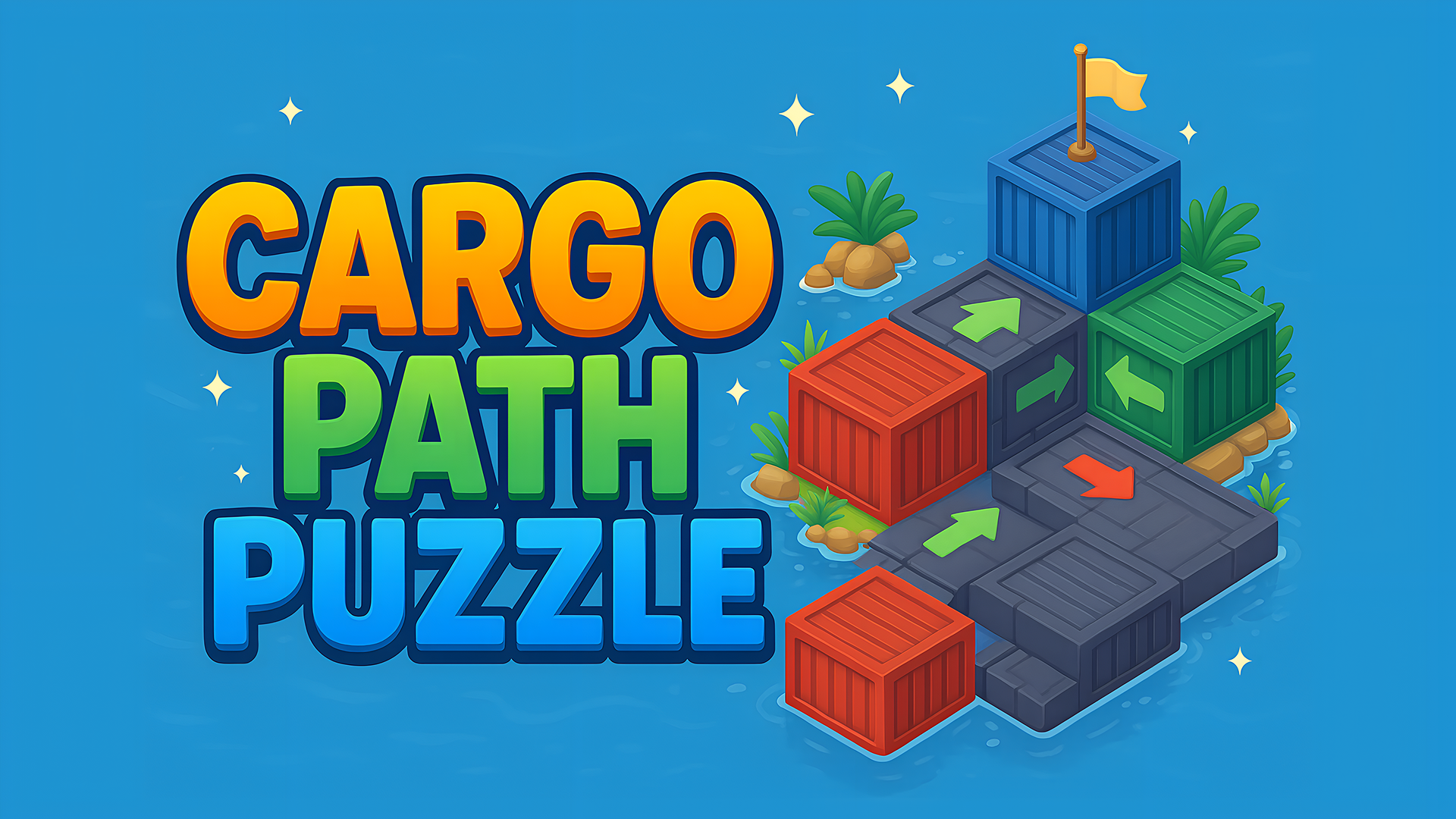
The game opened to its own full-screen menu after the Playgama loading sequence. Stacked shipping containers establish a port setting, while **New game** and **Settings** are the two clear choices in the center. The saved image is taken from that running build at 1280 by 720; it is not a listing thumbnail or a picture of this website.
This screen corrected an important misconception in an earlier draft. The game is not about removing screws. Its published controls describe a tile-based route challenge: collect every key, unlock a portal, then step onto that portal to finish. That makes route order, positioning, and carefully timed jumps the useful ideas to bring into a first attempt.
Keys define a forced sequence
Collect all keys, activate the exit portal, then reach it.
Levels include voids, collapsing blocks, trampolines, ice slides, and directional blocks.
The listing says each level has one correct solution; movement uses WASD/arrows, Space, and directional jump.
How keys force the route order
Do not treat the first visible key as an automatic first destination. Look for corridors, blocked tiles, and positions that may be difficult to revisit. If the portal sits beyond a one-way-looking section, count the remaining keys before entering that area. A short pause at the start can prevent a long reset.
The most useful mental model is a delivery route with required stops. Trace a rough loop through the keys, keep the portal as the final stop, and note where a jump could skip over a tile. If two orders appear possible, prefer the one that leaves more open space behind the character. Tight paths are easier to solve when the least flexible move is postponed until its purpose is clear.
Arrow keys or WASD move in four directions. Space performs a jump in the last direction moved and skips one tile. That last-direction rule deserves attention: tapping a direction to face an opening may change the next jump even when the character barely moves. Establish orientation before pressing Space.
Use deliberate taps until the grid spacing becomes familiar. Holding a key can produce an extra step on some browsers, and an accidental step may ruin a planned landing. The horizontal layout gives desktop players room to scan the board. Mobile behavior was not exercised, so touch users should rely on prompts shown by the loaded player rather than assuming a virtual keyboard will match the desktop instructions.
Begin by opening Settings and checking sound or input options, then return to New game. On the first board, identify the portal and count all visible keys. Move to the safest nearby key without jumping. Use the first jump only when the landing tile and the skipped tile are both understood.
If a route fails, change the order of one pair of keys instead of improvising a completely new path. That isolates why the previous route became blocked. A clean solution should feel like a planned sequence rather than a speed test; there is no benefit in rushing before movement repeatability is known.
This is a good match for players who like compact spatial problems, keyboard movement, and stages with a definite completion condition. It may also suit someone who prefers planning over reflex-heavy action. The port artwork gives the puzzle a practical theme without turning it into a vehicle simulator.
It is a weaker choice for visitors who want mouse-only play, a story campaign, or immediate touch instructions. Players sensitive to repeated restarts may want to confirm whether undo is available before committing to a longer session.
A commercial screen appeared ahead of the menu. The advertisement belongs to the external player and can vary by time or region. No claim is made that later stages are interruption-free, because a full level sequence was not completed.
The checked menu did not show purchases, prize claims, gambling elements, violent imagery, or adult themes. That observation applies only to the state captured on August 31, 2026. If the build, provider, or opening material changes, this page should be checked again.
A longer session should complete at least three stages, record whether jumps can create irreversible dead ends, and verify reset or undo behavior. It should also test keyboard focus after entering full screen and document any optional reward prompts. Until those steps are finished, the strongest supported conclusion is narrow: the current desktop build launches, exposes a clear port-themed menu, and describes a key-and-portal route puzzle with four-direction movement and directional jumps.
Mark keys, portal, and hazards first.
- Mark keys, portal, and hazards first.
- Plan collection order, not just arrival.
- Account for ice momentum and directional jumps.
- Restart early when the route is provably broken.
Collapsing ground makes collection order explicit
A key lies past collapsible ground: Plan the return path before collecting. Reaching a key can close the exit route.. A jump skips one tile: Use it to cross a void or bypass a trap. The rule turns spacing into a tool..
A key lies past collapsible ground
A key lies past collapsible ground
Plan the return path before collecting.
Reaching a key can close the exit route.
A jump skips one tile
Use it to cross a void or bypass a trap.
The rule turns spacing into a tool.
Plan collection order, not just arrival.
- Mark keys, portal, and hazards first.
- Plan collection order, not just arrival.
- Account for ice momentum and directional jumps.
Excellent for single-solution logic-platform fans.
Excellent for single-solution logic-platform fans.
Poor fit if trial-heavy movement irritates you.
Cargo Path Puzzle versus car escape parking
Cargo Path Puzzle asks key collection, portal activation, and final arrival across voids, collapsible blocks, trampolines, ice, and directional tiles. Car Escape Parking keeps movement inside each car’s lane and makes the order of moves the main decision.
Read the comparison overview →A rigorous route-order platform puzzle.
A rigorous route-order platform puzzle.
Editorial synthesis: Keys define a forced sequence
Keys define a forced sequence, so the central question is access order rather than raw distance. A short route that consumes a key too early can make the remaining cargo impossible to reach. The page adds value by teaching readers to mark prerequisites before optimizing movement and by separating a visible map from unverified rules about resets or penalties. It is a good fit for players who enjoy route planning with dependencies, not merely the shortest path.