Work backward from exit lanes, not from the nearest vehicle.
Which car must leave before the target can rotate or roll out?
This constructed dependency chain treats each blocker as a prerequisite, not a captured layout.
- TargetNeeds its exit lane clear
- Vertical blockerMust move out of the target lane
- Horizontal blockerControls the vertical blocker’s room
- Edge carMust leave before the horizontal blocker can shift
The true first move belongs to the earliest prerequisite, not necessarily the closest vehicle.
First bad decision
Move a nearby neutral car while the blocker chain is untouched.
- Tempting move
- Move a nearby neutral car while the blocker chain is untouched.
- Why it appeals
- It creates visible board activity.
- Actual cost
- The target still has the same number of prerequisites.
Before the next decision
Car Escape Parking: the four-point re-check
- Trace from target to edge.
- Mark vertical and horizontal dependencies.
- Find the car with no unresolved blocker.
- Reverse only when it changes a dependency.
Car Escape Parking’s opening screen
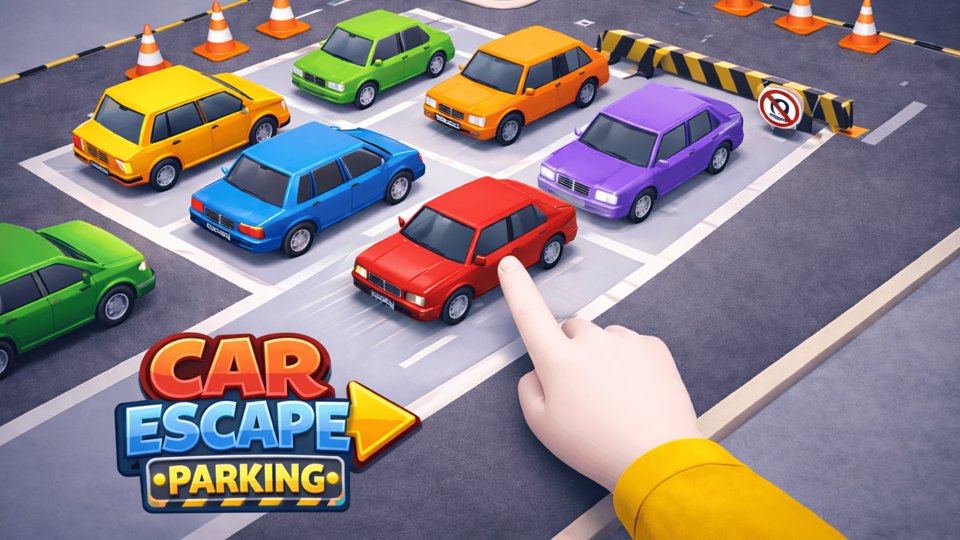
Level 1 loaded with a compact parking area, several vehicles, lane boundaries, and a **tap to play** instruction. The image on the listing is taken from this live board rather than a racing poster. Nothing on the opening screen involved road competition, vehicle damage, or real-world driving advice; it is a movement-order puzzle represented with cars.
The objective is to clear a safe exit by moving vehicles in a workable sequence. Each car occupies space that another may need, so the first vehicle moved is often more important than the speed of the gesture.
Work backward through two blockers
In a constructed parking problem, target car T needs an exit corridor occupied by A. A can slide back only into a space currently occupied by B; B has an open lane.
Move B first, then A, then T. Starting with the target car cannot solve the dependency because its corridor remains occupied. Moving an unrelated car may create more empty cells without releasing the one cell A needs. This backward chain produces a candidate order from the destination to the first movable blocker. Check the lane directions at every step instead of imagining a sideways escape the controls do not permit.
Letters denote an illustrative arrangement, not a level map. No collision tolerance or undo behavior has been measured.
How exit lanes set car order
Locate the vehicle that must leave and trace a straight path from its front or rear toward the boundary. List every car crossing that lane. Those blockers form a dependency chain: a blocker may itself need room created by a third vehicle.
Solve the outermost dependency first. Moving the target car repeatedly before its lane is open only returns it to the same constraint. When several vehicles can shift, prefer the one that creates space in the center rather than moving a blockage from one edge to another.
A long move is not automatically useful. Sliding a car to its maximum range can occupy a valuable gap. Move only far enough to release the next vehicle unless the game requires a complete exit.
Before each action, ask where the moved car will stop and which lanes it will cover there. A correct sequence should steadily reduce the number of crossings in the exit path. If that count increases, the move probably needs to be reversed or postponed.
The source instructions use dragging forward or backward along a car's allowed direction. On desktop, begin near the center of the vehicle and keep the pointer aligned with its lane. Diagonal movement may be ignored or interpreted incorrectly. On a phone, the portrait board fits comfortably, but closely packed vehicles may require precise short swipes.
No steering, acceleration, or keyboard scheme was shown. This is not a driving simulator despite the racing category. The opening board was understandable without sound, and vehicle orientation provided a visual direction cue independent of color.
Count the blockers in the target lane, then make the smallest move that frees the deepest blocker. Recount after every slide. If a vehicle can exit completely, remove it rather than leaving it in a new lane, provided the game allows that action.
When stuck, restart and write down the first three moves mentally. Change the earliest move that created a new crossing. This is more effective than swiping every car at random and makes later boards easier to analyze.
The game suits players who enjoy sliding-block logic, traffic themes, and short stages with an obvious finish. It can provide a calmer alternative to reflex racing. It is less suitable for visitors expecting speed, realistic parking practice, or free vehicle control.
The captured scene contained no injury, crash depiction, adult material, staking, or monetary prize. The vehicles function as general-audience puzzle pieces.
Playgama delivered a commercial message before Level 1. The external provider can change those messages and the build. We did not clear the board, trigger a collision warning, use a hint, or determine whether moves are counted.
Future testing should complete several layouts, verify undo and restart behavior, and record whether optional reward prompts interrupt progression. The current evidence supports the basic sliding-order mechanic and a working first board without suggesting that the full difficulty curve or economy has been measured.
Begin at the visible exit and trace backward. The car closest to leaving may be blocked by a second vehicle, which may itself need space currently occupied by a third. Writing that dependency mentally before tapping avoids moving every available car without purpose. Vehicles aligned with a lane should be tested only along that axis unless the game clearly demonstrates turning; assuming free steering would misread a sliding puzzle as a driving game.
The “tap to play” state does not yet reveal whether one tap sends a car until collision, selects it for another gesture, or moves it a fixed distance. That response should be documented because it determines how reversible a decision is. A longer review should intentionally choose the wrong vehicle, observe the feedback, and compare restart with undo. Clear collision indicators and consistent lane boundaries matter more here than animation speed, especially on a smaller touch screen.
Order of release is the real puzzle
The current controls describe dragging cars forward or backward along their lanes, rather than freely rotating them.
The goal is to move vehicles in an order that opens a safe escape path; the listing warns against collisions. It does not specify a universal move budget or checkpoint system.
Trace the target car’s full exit lane.
- Trace the target car’s full exit lane.
- Mark cars that move vertically versus horizontally.
- Free the car that unlocks the most lanes.
- Test one assumption at a time.
A blocking car has one open side
A blocking car has one open side
Move it in that direction only after checking its own exit.
A partial release can create a new block.
Two cars block each other
Find the third car or space that breaks the cycle.
Some boards require indirect sequencing.
Mark cars that move vertically versus horizontally.
- Trace the target car’s full exit lane.
- Mark cars that move vertically versus horizontally.
- Free the car that unlocks the most lanes.
Excellent for compact sequencing and no-timer planning.
Excellent for compact sequencing and no-timer planning.
Less suitable if you want open driving.
Car Escape Parking versus coffee color blocks
Read the comparison overview →Choose it for constrained order-of-operations puzzles.
Choose it for constrained order-of-operations puzzles.
Editorial synthesis: Work backward through two blockers
Car Escape Parking is a dependency puzzle disguised as a sequence of small movements. The useful question is not which car can move now, but which blocker must leave first for the target route to exist. The article therefore emphasizes working backward from the exit and separating a temporary parking space from a permanent obstruction. That gives readers an actionable way to assess the game before investing time: if they enjoy tracing prerequisites and revising a route, the mechanic should feel legible; if they prefer direct objectives with little setup, the required staging may feel slow.