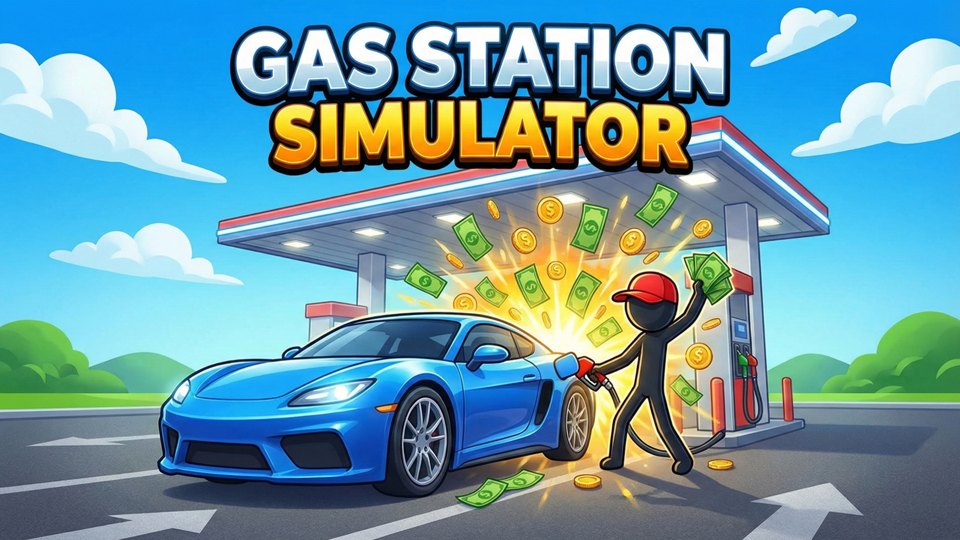
Close one service loop before opening a second income stream.
What does the first pump teach before you buy more?
This management flow separates arrival, service, payment, and reinvestment; it is not a completed run.
| Stage | Decision | Bottleneck signal | Next action |
|---|---|---|---|
| Arrival | Guide the customer cleanly | Cars wait outside | Improve entry flow |
| Service | Use the first pump fully | Player shuttles too much | Reduce movement before expansion |
| Payment | Collect and reinvest | Income stalls | Buy the most repeated bottleneck |
| Second station | Only after loop one is stable | Both stations idle | Delay until staffing/route is clear |
One stable arrival-to-payment loop is a better expansion base than several half-served pumps.
First bad decision
Open another pump while the first loop still requires constant backtracking.
- Tempting move
- Open another pump while the first loop still requires constant backtracking.
- Why it appeals
- More capacity looks like growth.
- Actual cost
- It can multiply the same movement bottleneck.
Before the next decision
Gas Station Simulator: the four-point re-check
- Complete one arrival-to-payment loop.
- Identify the repeated walking or waiting cost.
- Buy for the bottleneck, not the largest visible upgrade.
- Open capacity only after the loop is stable.
Gas Station Simulator’s opening screen
The source build loaded directly into an overhead tutorial rather than a separate title menu. A small station lot, a character, and a highlighted fuel-pump area were visible. The tutorial card showed WASD movement and mouse movement, while a 100-cash purchase marker stood beside the pump. The account display in the upper-right showed 140, making the first upgrade affordable in that starting state.
This is stronger evidence than a catalog description because it confirms the initial control scheme and the first economic decision. It does not establish the full upgrade tree, long-term balance, or later advertising frequency.
Use a small capacity calculation to choose an upgrade
In a constructed station, one pump serves a car every 30 seconds: at most two cars per minute. Three cars arrive per minute, and there is enough staff to serve a second pump.
The queue grows by about one car per minute. A second pump raises theoretical capacity to four cars per minute and can address this bottleneck. If instead one worker can operate only one pump at a time, buying the second pump alone may leave capacity at two. Locate the limiting resource before paying for an upgrade; pump count and staffed throughput are different quantities.
All rates are example assumptions, not measured values from this game. The calculation ignores travel time and other station activities.
How pump queues set expansion order
The game combines direct character movement with a simple business cycle. The player walks around the forecourt, serves or refuels vehicles, earns cash, and spends that cash on equipment or expansion. Progress is expressed physically: a new station feature appears in the world rather than only changing a spreadsheet number.
The starting tutorial points toward a hands-on simulator, not an idle page that runs entirely by itself. Efficient play should reduce the distance between repeated jobs while keeping enough cash available for the next useful purchase.
Follow the tutorial long enough to understand interaction range before buying optional items. Purchase the required pump when prompted, then observe how a car signals that it needs service. Learn the complete earning cycle once—approach, interact, wait or fill, collect—before trying to optimize it.
If customers queue faster than one player can serve them, speed or automation may be more valuable than decoration. If the station sits empty, expanding demand could matter more than shortening a task.
The live tutorial explicitly displayed WASD and mouse input, so desktop keyboard-and-pointer play is supported in the observed build. The overhead camera and broad buttons were readable across a 16:9 viewport. We did not verify gamepad controls or a touch-specific interface.
The tutorial overlay dims the world while explaining movement. Players should wait for it to finish before judging the contrast of the normal scene. Small purchase labels may be easier to read on a laptop or desktop than on a phone.
The Playgama export placed an advertisement before the tutorial. Inside the game, cash prices and progression prompts are visible, but we did not determine whether cash is earned only through play, whether purchases exist, or whether later upgrades require rewarded ads. Those are important unknowns for parents and players who avoid monetized progression.
Simulation games can also become repetitive when each customer requires the same route. The real quality test is whether new equipment changes decisions or merely increases waiting. Our short inspection cannot settle that long-term question.
Gas Station Simulator is aimed at players who like incremental expansion but still want to move a character and perform jobs directly. It may not suit someone expecting a realistic fuel-industry model, complex accounting, or a story campaign. The appeal is lighter: complete visible tasks, turn income into a new station feature, and watch the small site grow.
Playgama supplied and hosted the research build; this article describes its live tutorial from August 31, 2026. Controls, ads, balance, and availability may change at the provider.
The visible 140 balance and 100-cost pump create a useful early decision, but they do not prove that buying immediately is optimal. Before spending, a player should walk the lot once, note which stations or customer markers already respond, and check whether income can be earned with the starting equipment. If the tutorial locks every other action, the purchase is onboarding rather than a genuine economic choice. If work is possible first, keeping 40 cash in reserve may matter when a second repair or supply cost appears.
This distinction is what a longer management review should measure. We would record the time from serving a customer to receiving cash, compare the price and income of two consecutive upgrades, and note whether walking time grows as the lot expands. Those observations would show whether progress comes from planning or simply waiting. Until that test is complete, the reliable advice is modest: learn the movement path, read each price before entering its marker, and do not treat a highlighted purchase as evidence of the whole economy.
Bottlenecks decide expansion order
The current source describes fueling cars, collecting cash, adding pumps, hiring staff, and upgrading service.
Its PC instructions list WASD movement and mouse interaction; touch input is listed for mobile. No measured service rate, upgrade price, or offline earning amount is available here.
Watch one full customer journey.
- Watch one full customer journey.
- Name the slowest repeated task.
- Upgrade the constraint, not everything at once.
- Re-measure after each change.
Cars queue at pumps
Cars queue at pumps
Add pump capacity or improve flow before cosmetic upgrades.
Queue length is the immediate constraint.
Staff cannot keep up
Expand service only after identifying the slow task.
More demand can worsen an unresolved bottleneck.
Name the slowest repeated task.
- Watch one full customer journey.
- Name the slowest repeated task.
- Upgrade the constraint, not everything at once.
Great for operations-minded incremental play.
Great for operations-minded incremental play.
Avoid if you dislike maintenance loops.
Gas Station Simulator versus build a rollercoaster simulator
Both describe currency-funded expansion. Gas Station ties progress to servicing demand and staff; Rollercoaster ties it to track construction and rides. Choose operational scheduling or layout construction rather than comparing only their simulator labels.
Read the comparison overview →A practical bottleneck-management exercise.
A practical bottleneck-management exercise.
Editorial synthesis: Use a small capacity calculation to choose an upgrade
The page focuses on capacity because small operational games often hide their strategy inside queues, storage, and upgrade timing. A larger upgrade is only helpful when the bottleneck is capacity rather than service speed or cash flow. The article gives readers a way to identify that bottleneck before spending, and it keeps unverified revenue claims separate from the source description. That makes the review useful for players who enjoy light management but want to know whether choices have visible consequences instead of simply unlocking the next button.