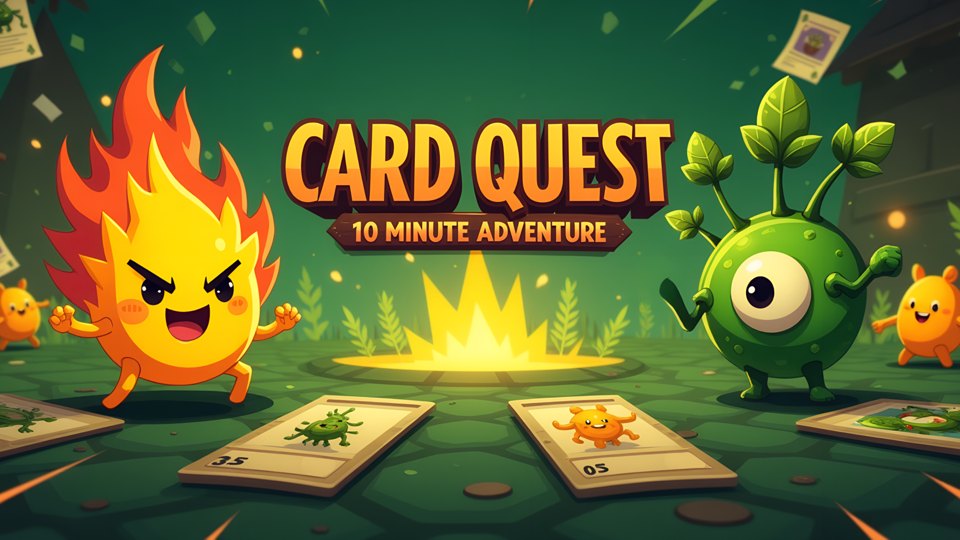
Read card play as tempo spend, not only damage.
What does this card buy on the next turn?
This constructed tempo ledger treats cards as abstract resources; exact deck rules remain source-limited.
| Play | Current gain | Next-turn position | Use when |
|---|---|---|---|
| Efficient attack | Reduces an enemy | May leave no defense | The threat is immediate |
| Setup card | Small visible effect | Improves next action | A larger combo is already visible |
| Hold a card | No board change | Preserves choice | The current play would waste tempo |
A short adventure rewards cards that keep the next meaningful choice open.
First bad decision
Spend the setup card for a tiny immediate effect.
- Tempting move
- Spend the setup card for a tiny immediate effect.
- Why it appeals
- It shows progress on the board.
- Actual cost
- The stronger following turn may no longer be available.
Before the next decision
Card Quest: 10 Minute Adventure: the four-point re-check
- Name the next threat before playing.
- Separate damage from setup value.
- Ask what the held card protects.
- Keep the run inside its short decision arc.
Card Quest: 10 Minute Adventure’s opening screen
After closing the Playgama advertisement, the game loaded a stylized wooden room with a green card table in the foreground. Cards, a drink, snacks, and animated props surround the board, while a large instruction says Tap anywhere to Start. This is not a static cover image: it is the live entry scene immediately before play.
The title promises a short adventure, but we did not time a complete run. Ten minutes should be treated as the game's framing, not a guaranteed duration for every player or restart.
Terrain turns cards into positions
The current instructions describe a customizable deck, turn-based resource spending, and battlefield zones that permit different creature roles.
Cornfields favor attackers, Sandlands defenders, Candy Kingdom healers, and Useless Swamp special or direct-damage units; Rainbow creatures are described as flexible across terrains. The ten-minute title is not a measured session duration.
How terrain redefines unit strength
The design appears to condense tactical card choices into a brief session. Cards likely represent attacks, defenses, resources, or effects, and the player must read a small hand rather than manage a large collectible deck. The central question each turn is whether to solve the immediate threat or preserve a stronger combination for later.
Short structure can make every card matter. Spending defense too early may leave no answer for a final attack; saving everything may cause avoidable damage now.
Once the table activates, read every visible number and icon before choosing. Identify the cost system, current health, and whether unused cards persist to the next turn. Use the first encounter to learn the consequence of one attack and one defensive action.
If a card's wording is unclear, play it in a low-risk moment and observe the whole result rather than guessing from artwork.
The entry prompt explicitly accepts tap input, so mouse and touch should start the game. Card selection and drag behavior were not fully verified. The 3D room uses a wide desktop canvas, but text on individual cards may require a larger display or hover enlargement.
We did not inspect keyboard navigation, screen-reader labels, text scaling, or color-blind support. Players who need those features should verify the live interface before relying on it.
The provider export showed a full-screen advertisement before the table during private editorial testing. This public review does not request, host, embed, or link to that runtime. We did not test later interstitials, purchases, reward ads, save state, or whether the card set changes between runs.
The humorous room includes bottles and a rough fantasy atmosphere, which some parents may want to preview. Our brief inspection did not establish violence level, age rating, or all themes.
Card Quest is for players who enjoy tactical card decisions but do not want a long campaign setup. It may not satisfy someone looking for deck collection, multiplayer ranking, or fully documented accessibility. The most useful first-run test is whether card outcomes are explained clearly enough to learn within the short format.
The table scene establishes atmosphere, but the first playable hand should answer more important questions. Read every visible card before choosing one and identify which information is certain: immediate damage, defense, cost, draw effect, or a condition that resolves later. Then watch whether the opponent previews its next action. A short card adventure can feel strategic only if consequences are legible enough to compare within its compressed run time.
Do not assume the title's ten-minute framing means there is no persistence. A future test should time one complete attempt, restart once, and note whether decks, encounters, or rewards change. It should also record what happens when a card cannot be afforded, whether discarded cards return, and whether a loss offers an ad-based continuation. Those checks would distinguish a compact tactical run from a mostly scripted sequence. Until they are made, the responsible conclusion is limited to a functioning entry scene, a card-table presentation, and an explicit invitation to begin.
A strong card can still be the wrong playable choice
Assume a constructed hand contains an attacker and a healer, but the open zone is a healing terrain. A flexible creature is also available at a different resource cost.
Check terrain eligibility before comparing raw card strength: an attacker that cannot be deployed in the open zone is not an executable move. Then compare spending on healing with preserving resources for the flexible creature. The value of a card depends on legal space, the current opponent, and what remains in the hand. A universal “play the strongest card” rule ignores the terrain system that distinguishes this concept.
No card statistics, costs, optimal deck, or match result is asserted. The hand is an illustrative decision, not a saved battle.
A strong unit has poor terrain
A strong unit has poor terrain
Move or protect it before committing.
Role strength depends on placement.
Enemy threatens two lanes
Use a control card that delays, not only damage.
Time can be more valuable than one attack.
Identify terrain bonuses before choosing units.
- Identify terrain bonuses before choosing units.
- Assign roles: attack, hold, support.
- Plan two enemy actions ahead.
- Preserve an answer for the worst threat.
Assign roles: attack, hold, support.
- Identify terrain bonuses before choosing units.
- Assign roles: attack, hold, support.
- Plan two enemy actions ahead.
Excellent for compact tactical planning.
Excellent for compact tactical planning.
Less suitable if you want long campaign depth immediately.
Card Quest: 10 Minute Adventure versus gas station simulator
Both involve allocating resources, but Card Quest does so through discrete opponent-facing turns and terrain eligibility. Gas Station describes ongoing service capacity. Prefer tactical timing or operational growth according to the kind of tradeoff you enjoy.
Read the comparison overview →A smart short-form tactics package.
A smart short-form tactics package.
Editorial synthesis: A strong card can still be the wrong playable choice
A powerful card is not automatically the right playable card. The article asks the reader to compare immediate strength with timing, resource cost, and the next turn's options. That makes the short-session format meaningful: a ten-minute run can still contain sequencing decisions, and a flashy effect can be wasteful if it closes the route to a later answer. The page is useful to readers who want compact planning rather than a full collectible-card system, while its limits make clear which deck and balance questions remain unverified.