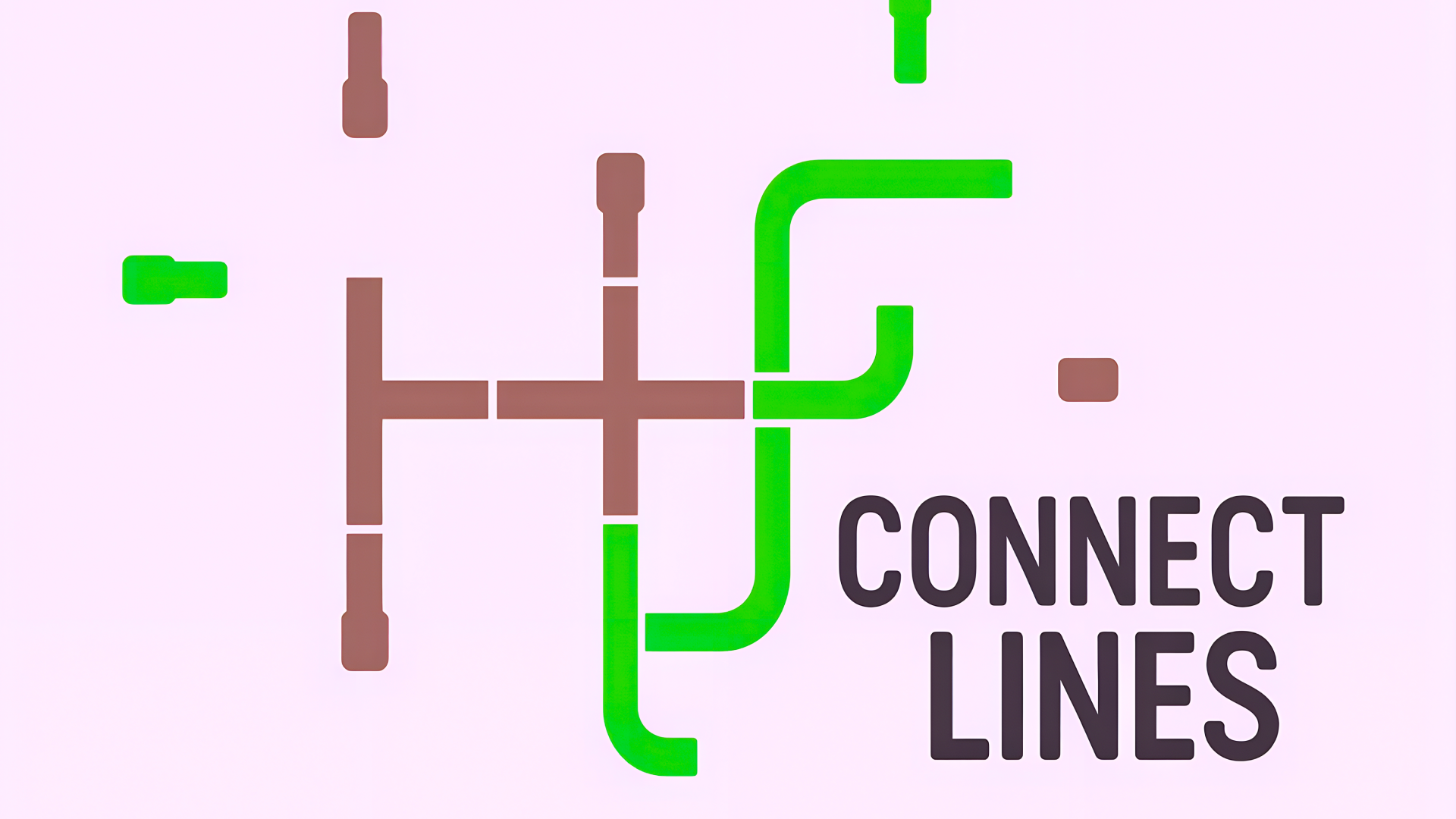
Rotate from the most constrained loose end outward.
Which endpoint has only one sensible rotation?
This rotation model uses neighbor counts to order decisions; it is not a captured board.
- Corner/edge endpointOften has one useful direction
- Loose endForces the adjacent piece’s orientation
- Connected middleFollows after endpoints are stable
- Flexible centerAdjusts last
A single-neighbor endpoint removes more uncertainty than an apparently complete center segment.
First bad decision
Rotate a satisfying center connection before checking single-neighbor ends.
- Tempting move
- Rotate a satisfying center connection before checking single-neighbor ends.
- Why it appeals
- The middle looks almost complete.
- Actual cost
- A loose end may require undoing the center path.
Before the next decision
Connect Line: the four-point re-check
- Count open neighbors for each piece.
- Rotate constrained ends first.
- Preserve at least one loose-end direction.
- Verify the whole path after each frontier change.
Connect Line’s opening screen
The browser build produced a stable in-engine title screen after the Playgama pre-load sequence. The evidence image is the game canvas itself at full viewport size. It confirms that the current URL delivers the expected title, but repeated attempts during this session did not advance reliably to a puzzle board.
That limitation changes how this guide is written. The network-rotation rule below comes from the published control instructions, while no particular grid size, timer, or level objective is presented as personally completed.
Rotate from constrained pieces outward
Line segments rotate to form one connected network.
Every piece must join without loose ends.
Larger boards add shapes and adjacency effects.
How loose ends reveal rotations
Each board contains straight or curved line segments. Clicking a piece rotates it, usually by a fixed quarter turn. The aim is to create one continuous path or network in which every segment is connected correctly and no loose end points into empty space.
Start with the least ambiguous pieces. A corner tile placed in a corner has only a small number of useful orientations. A straight segment on an edge cannot point outside the board if the final network must remain closed. These boundary constraints reduce the number of possibilities before the busy center is considered.
Inspect all four edges and rotate obvious pieces first. Next, identify junctions that must accept several connections. Leave flexible curves near the center until the surrounding directions are known. This method avoids repeatedly spinning every tile without learning anything.
After each change, trace a path with your eyes from one established endpoint. Stop at the first broken connection and address that local area. Trying to understand the entire network at once is slower and makes accidental reversals harder to notice.
Random clicking can occasionally produce progress, but it does not provide a reliable method. Give each tile a reason: boundary fit, continuation of a confirmed path, or satisfaction of a junction. If none applies, postpone that tile.
When a section appears complete, check for a closed loop that isolates it from the rest of the board. A visually tidy loop may still violate the requirement for one unified network. Keep at least one outward connection until the surrounding components are joined.
The described input is a mouse click or screen tap. No drag gesture or keyboard map was provided. On a portrait board, small segments may require careful inspection, especially where several curves meet. Zoom behavior and high-contrast settings were not available from the title screen we reached.
Sound should not be necessary for a rotation puzzle, but that assumption still needs confirmation inside a level. Players with fine-motor difficulties may want larger touch targets or a desktop pointer if individual tiles are compact.
Choose it for quiet spatial reasoning, route tracing, and problems that can be reduced through constraints. It should appeal to people who enjoy pipe puzzles or circuit-style networks without needing a physics simulation. It is a poor match when you want fast action, a fully verified first-level demonstration, or dependable keyboard control.
The observed title screen and supplied rule contained no adult material, staking, realistic harm, or cash-prize promise. Its concept is a general-audience logic exercise.
The external player showed a pre-load advertisement. Advertising and runtime behavior can vary, and znvrgames does not select those messages. Since the interactive board did not appear consistently, this title deserves a stricter availability check than the other additions.
A follow-up should load the game on two browsers, capture the first puzzle, rotate a complete edge, and finish one network. If that cannot be reproduced, the listing should be removed from the public set. For now, the page openly separates the confirmed launch from the intended rule instead of inventing a successful play session.
Start with corners and single-neighbor pieces.
- Start with corners and single-neighbor pieces.
- Mark endpoints that must connect.
- Rotate one ambiguous piece at a time.
- Verify the whole network, not just a region.
Loose endpoints reveal the next rotation
A piece has only one open neighbor: Fix its orientation before branching. Forced pieces anchor the solve.. A loop almost closes: Check whether it strands a loose segment. A local connection can globalize failure..
A piece has only one open neighbor
A piece has only one open neighbor
Fix its orientation before branching.
Forced pieces anchor the solve.
A loop almost closes
Check whether it strands a loose segment.
A local connection can globalize failure.
Mark endpoints that must connect.
- Start with corners and single-neighbor pieces.
- Mark endpoints that must connect.
- Rotate one ambiguous piece at a time.
Great for calm topology-style reasoning.
Great for calm topology-style reasoning.
Less ideal for action players.
Connect Line versus run the electricity
Connect Line’s rule is broad connectivity: rotate segments until every endpoint joins. Run The Electricity adds a lamp-and-wire circuit goal, and its source explicitly removes time pressure.
Read the comparison overview →A satisfying network-completion puzzle.
A satisfying network-completion puzzle.
Editorial synthesis: Rotate from constrained pieces outward
The reliable way to begin a Connect Line board is from constrained pieces outward. A segment with only one legal continuation supplies evidence; an open central segment usually does not. The article turns that observation into a practical solve order and explains why random rotation feels inefficient. It also gives the reader a useful comparison with electricity-style puzzles: both require continuity, but this mechanic places more weight on local degree and endpoint pressure.