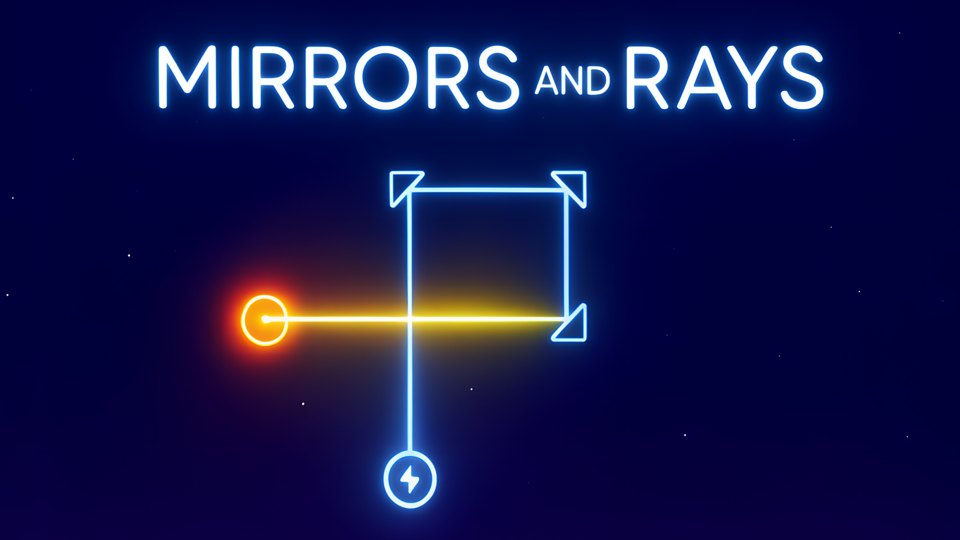
Predict the second bounce before firing the first ray.
Where does the ray go after the obvious mirror?
This bounce model traces direction change abstractly; no captured beam path is asserted.
| Stage | Direction | Surface | Planning result |
|---|---|---|---|
| Fire | Toward first mirror | Known | Only the entry angle is settled |
| First bounce | Turns according to mirror | Known | Predict the next target |
| Second contact | Unknown until first bounce | Possible blocker | Do not commit yet |
| Exit/target | Must remain aligned | Goal | Work backward from it |
The second contact, not the dramatic first reflection, decides whether the ray is useful.
First bad decision
Place for a dramatic first reflection while ignoring where the redirected ray exits.
- Tempting move
- Place for a dramatic first reflection while ignoring where the redirected ray exits.
- Why it appeals
- The first mirror interaction is easy to see.
- Actual cost
- The second contact may point away from the target or into a blocker.
Before the next decision
Mirrors and Rays: the four-point re-check
- Name entry direction and mirror type.
- Predict at least two contacts.
- Trace backward from target when possible.
- Adjust the earliest controllable mirror first.
Mirrors and Rays’s opening screen
The running game entered Level 1 with a light source, several rotatable optical elements, and a bulb target. Its on-screen instruction said, **Rotate the elements to guide the beam to the light bulb.** A bright line made the current route visible. The screenshot records this interactive teaching state rather than a stylized source cover.
The rule is direct, but a board can still require several linked reflections. Each mirror changes the beam's direction, and one incorrect angle prevents every later element from receiving light.
One rotation can rewrite the route
The current source describes clicking mirrored elements to redirect a ray and charge all light-bulb targets.
It does not specify every mirror angle, whether rays split, or whether a ray stops after its first target. Those omissions prevent an exact commercial-level solution from the description alone.
How reflections turn one move into a route
Start at the target and ask which neighboring direction could deliver the final ray. That determines the useful orientation of the last mirror. Then trace backward toward the source. Backward reasoning often removes more possibilities than rotating the first mirror repeatedly.
If several bulbs appear later, find shared sections of the route. A mirror that can serve two targets is likely more important than one that lights a single short branch. Treat junctions as fixed commitments only after both outgoing paths are understood.
Rotate a mirror once, observe the entire beam, and note where it stops. Do not click several pieces quickly because the cause of the new path becomes unclear. The visible ray is immediate feedback; use it as a diagnostic line rather than decoration.
When a route almost reaches the target, inspect the first incorrect turn, not the final empty space. The mistake often occurs earlier, where one reflection sends the beam parallel to the required path. Restoring that segment may solve several downstream positions at once.
The controls use clicking or tapping on mirrored elements. No dragging or keyboard command was shown. On desktop, the field is broad enough to separate objects. On touchscreens, small mirrors near one another may be easier to rotate in portrait orientation if the canvas scales cleanly.
Contrast between the ray and background is essential. The tutorial's bright beam was easy to follow in the captured frame, but alternate colors, reduced glow, and sound cues were not tested. Players sensitive to luminous effects should inspect settings before a long session.
Identify the source, bulb, and every adjustable object. Predict the last reflection, then set one mirror at a time from target to source. After each click, trace the beam with your eyes from the beginning and verify that no earlier segment was lost.
If the light loops or exits the field, return to the mirror where that behavior begins. Randomly resetting the entire board throws away confirmed segments. A partial route that consistently reaches the same element is progress.
This title fits players who enjoy geometry, cause-and-effect puzzles, and quiet visual experimentation. It does not require real electrical work or knowledge of optics beyond reflection. Visitors wanting action, narrative, or competitive scoring may find the measured pace too restrained.
The inspected scene used abstract light and household-style bulbs. It contained no dangerous instruction, adult content, violent depiction, gambling language, or monetary reward.
The Playgama player displayed a pre-load advertisement. Later advertising and reward prompts remain under the provider's control. We did not finish Level 1, count moves, use hints, or determine whether later boards introduce splitters, colored beams, or timed objectives.
A broader test should complete several stages and document every new optical element. Presently, the strongest evidence is the explicit tutorial prompt, the visible ray response, and a working first board. Those observations support practical reflection tactics without claiming knowledge of mechanics that never appeared.
Instead of rotating the first mirror repeatedly, begin at the bulb and identify the direction from which the final beam must arrive. Then find the optical element capable of producing that segment and work backward toward the source. This reduces trial and error because each mirror is assigned a job in a continuous route. After rotating one element, follow the bright line to its new endpoint before changing another.
A useful interface test is whether the beam updates immediately and whether a selected mirror has a clear focus indicator. Without those signals, a correct geometric idea can feel unresponsive. Later testing should also determine the available rotation increments, whether mirrors reflect from both sides, and whether barriers absorb or merely stop the ray. Those rules should be learned from observed feedback rather than assumed from real-world optics, since puzzle systems often simplify physical behavior.
Trace the ray from source to current break.
- Trace the ray from source to current break.
- Mark mirrors with more than one useful outcome.
- Change one mirror at a time.
- Re-trace after every rotation.
Change the first wrong reflection
Imagine a constructed route from source S to mirror M1, then M2, then target T. The observed ray reaches M1 but leaves toward an empty edge.
Investigate M1 before rotating M2: a downstream mirror cannot redirect a ray that never reaches it. Change one orientation, trace the next interaction, and only then work farther along the path. This isolates cause and effect. In a real board with splitting rays or multi-target paths, track every outgoing branch; a simple single-route drawing would otherwise conceal an unlit target.
No particular angle or target order is asserted for this title. The example assumes a single ray until a different rule is established.
Ray reaches a mirror
Ray reaches a mirror
Consider both outgoing directions before turning it.
The local choice changes downstream targets.
Target is almost aligned
Adjust the upstream mirror, not only the final one.
A late fix may be symptom, not cause.
Mark mirrors with more than one useful outcome.
- Trace the ray from source to current break.
- Mark mirrors with more than one useful outcome.
- Change one mirror at a time.
Excellent for spatial因果 reasoning.
Excellent for spatial因果 reasoning.
Poor fit if rapid trial-and-error feels tedious.
Mirrors and Rays versus run the electricity
The electricity listing explicitly asks for a closed circuit and says there is no timer. This mirror listing describes target illumination and leaves timing unspecified. A route preference can transfer, but the circuit goal and timer claim cannot.
Read the comparison overview →A precise light-routing puzzle for systematic readers.
A precise light-routing puzzle for systematic readers.
Editorial synthesis: Change the first wrong reflection
Mirrors and Rays is most readable when a player diagnoses the first wrong reflection instead of rebuilding the entire chain. One early angle error can make every later segment appear wrong, so the article proposes checking the route from source to first divergence, then changing the smallest responsible piece. That method reduces random experimentation and gives the reader a practical reason to try the game. Its value is not a promise that every puzzle is easy; it is a compact debugging model for visual path problems.