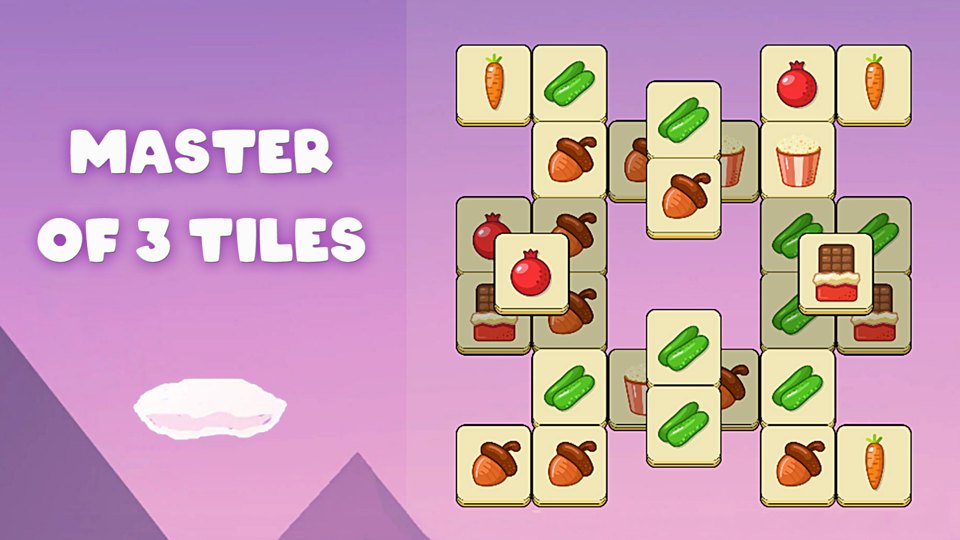
Separate visible tiles from selectable tiles before committing.
Which visible triple is actually reachable?
This constructed board separates visibility from access; it does not assert a captured tray size.
Only the first A triple is confirmed. The B plan must wait until the covered B becomes selectable.
First bad decision
Take two visible Bs while planning around a covered third B.
- Tempting move
- Take two visible Bs while planning around a covered third B.
- Why it appeals
- It feels closer to a completed triple.
- Actual cost
- Without a documented release rule, the pair can block the tray before the third becomes available.
Before the next decision
Master of 3 Tiles: the four-point re-check
- Count selectable copies, not visible copies.
- Name the third tile before taking a pair.
- Check whether covering layers have a known release rule.
- Clear a confirmed triple before pursuing a potential one.
Master of 3 Tiles’s opening screen
The previous draft described a verified sequence of selecting three apples on one board. That claim is withdrawn. Multiple other symbols differ between the two retained board images; the images alone cannot establish their temporal relationship or the cause of those differences.
There is a menu capture and two different board captures. Their historical filenames are preserved for traceability, not accepted as proof of a successful match. No conclusion is made about whether a restart, shuffle, animation, capture error, or another mechanism caused the differences.
Choose a triple without assuming hidden partners
Consider a constructed choice with three selectable As and only two selectable Bs. A third B appears to be covered; the written source has not established when it becomes selectable.
The As provide a currently complete group. The Bs provide only a possible future group. Listing matching pictures somewhere on a board is therefore a weaker plan than identifying three pieces you can actually reach. If a game also has a limited tray, count the intervening selections before committing; our separate seven-slot model demonstrates that extra constraint.
The tile letters and choice are an editorial example, not a captured level. No tray size or clearing sequence is asserted for this game.
What makes a visible triple reachable
This note is private and excluded from the public allowlist, APIs, discovery, and sitemap. It is not a gameplay review or a recommendation. The original disputed text is preserved in docs/p0-remediation-2026-10-20/master-of-3-tiles-withdrawn.md as a withdrawn historical draft.
Before writing a new field report, retain a continuous operation record from the menu through a stable board, every selection, tray change, match resolution, and stable resulting board. Explain any intervening restart or shuffle. Record an outcome and recovery path relevant to the review's reader task, then review each factual claim against that record. Do not infer mobile support, long-term advertising, purchases, or later difficulty from a desktop opening state.
Reachability beats a promising pair
The current listing defines the objective as removing identical tiles in groups of three, with more demanding arrangements as levels progress.
Its written instructions do not establish a tray capacity, the treatment of covered tiles, or the timing of a failure check. Our earlier screenshot-based claim about one continuous three-apple match remains withdrawn.
Three visible As and two visible Bs
Three visible As and two visible Bs
Clear As now; treat Bs as potential, not available.
A confirmed triple removes uncertainty immediately.
A third B appears covered
Delay the B plan until it becomes selectable.
Assuming reachability can lock the tray.
Count selectable copies, not visible copies.
- Count selectable copies, not visible copies.
- Name the third tile before taking a pair.
- Re-check the tray after every pick.
- Avoid planning around a tile whose release rule is unknown.
Name the third tile before taking a pair.
- Count selectable copies, not visible copies.
- Name the third tile before taking a pair.
- Re-check the tray after every pick.
Good for short pattern-recognition sessions with visible boards.
Good for short pattern-recognition sessions with visible boards.
Weaker fit if you need documented tray, undo, or level rules before playing.
Master of 3 Tiles versus tile match
Tile Match explicitly describes pieces descending toward a losing border. Master of 3 Tiles is described in terms of groups of three. The titles sound similar, but only the former source establishes that moving deadline.
Read the comparison overview →A focused triple-match decision exercise; verify the live tray rule against your preference.
A focused triple-match decision exercise; verify the live tray rule against your preference.
Editorial synthesis: Choose a triple without assuming hidden partners
The editorial question is reachability. A board can show several matching pictures while only one group is actually selectable, and the difference determines whether a player makes progress or fills a tray with hopeful pairs. The page deliberately treats the hidden third tile as unknown and turns that uncertainty into a repeatable reading method: count available copies, identify the release condition, then commit only when the next removal is visible. That method remains useful even if the live game changes its tray size or level art. It also explains why this page should not claim a verified solution from a still image. The value is in teaching a safer decision process under incomplete information.