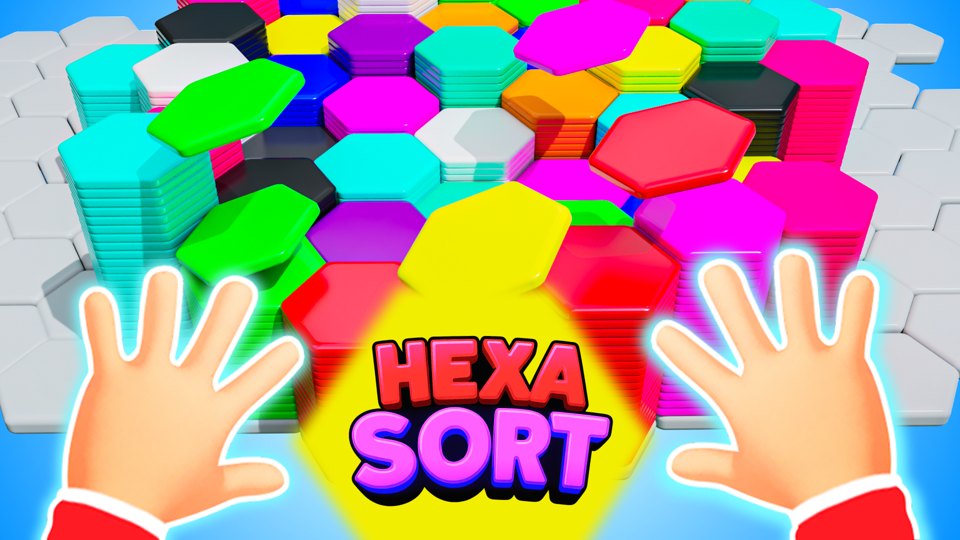
Judge a stack by the six neighbors it liberates or traps.
Which placement reduces fragmentation after the merge?
This hex neighborhood model uses labels, not a captured level.
Three same-color contacts can be excellent only if the empty sector still leaves an exit route.
First bad decision
Force the third same-color contact while walling off the only empty side.
- Tempting move
- Force the third same-color contact while walling off the only empty side.
- Why it appeals
- It appears closest to a merge.
- Actual cost
- The next candidate may have no usable approach route.
Before the next decision
HexaSort: the four-point re-check
- Count same-color contacts and open sides.
- Ask which cells become available after a clear.
- Do not create a color island with one entrance.
- Recheck all six directions, not just the obvious line.
HexaSort’s opening screen
The game passed its Unity loading screen and opened a vertical field of gray hexagonal slots. Three colored tile stacks waited below, an animated hand traced a placement toward the board, and coin and progress counters appeared across the top. Three helper icons were visibly locked until later levels. This actual tutorial frame is used for the listing image.
Blue and green stacks made the central mechanic readable: place groups on the hex grid so matching colors become adjacent and can consolidate. The six-sided layout creates more neighboring directions than a square board.
Neighborhoods change after every placement
Playgama describes placing hexagonal tiles so matching colors become neighbors, causing columns to merge and disappear.
The source mentions hints but does not give a numeric trigger, a full multicolor resolution order, or a promise that every matching neighbor clears immediately.
How six-way neighbors change placement
Every interior cell can touch six others. Before placing a stack, scan the full ring around the destination rather than looking only left and right. A position may connect two same-colored groups across different diagonal directions.
Edge cells have fewer neighbors and are safer for colors that do not yet have partners. Central cells are more flexible, so reserve them for stacks that can link multiple groups or trigger a useful chain.
An immediate color match is valuable only if the merged stack leaves room for the next pieces. Avoid filling a narrow central bridge with a color that has no follow-up. Keep at least one route between open regions of the board.
When a stack contains several visible layers, the top color may change after consolidation. Consider what will be exposed next. A move can create a second match automatically, but it can also reveal an isolated color in an inconvenient location.
The tutorial uses a drag gesture from the lower stack area to a hex cell. On desktop, move slowly until the destination highlights, then release at the center. On a phone, the portrait layout is natural, although a finger may cover the target hex near the bottom.
No keyboard mapping was shown. Color is a primary signal, and no patterns or labels were confirmed. Players with color-vision differences should inspect settings before relying on similar hues. The first move could be understood without audio.
Survey the three available stacks before choosing one. Place the least flexible color near a compatible group while keeping the middle open. After the merge animation ends, wait to see whether layers move automatically before starting another drag.
Use the progress counter as feedback, not as the only goal. A move that advances the count while dividing the board may create a later dead end. If a restart is needed, change the first central placement and compare how much open connectivity remains.
This is a good fit for players who like color sorting, spatial merging, and chain reactions on a compact board. The hex geometry gives a familiar merge idea a different planning surface. It may not suit visitors who need non-color identifiers, want keyboard control, or prefer puzzles with a fixed solution instead of score progression.
The inspected board contained no adult content, realistic violence, gambling, or cash prize. Its bright abstract pieces are presented as a general puzzle rather than a child-specific activity.
The top bar included a coin value, and three tools were locked behind Level 3, Level 5, and Level 8. Their effects and cost were not tested. Playgama also displayed a commercial message before Unity loaded; later reward prompts may vary.
A fuller session should complete the first level, document the merge threshold, and unlock each tool through ordinary play. The evidence currently proves a functioning hex board, drag placement, visible progression locks, and color adjacency without asserting how the untested economy behaves.
Each interior hex can touch six positions, making central spaces powerful but easy to congest. Before placing a stack, count how many matching colors it can contact immediately and which empty neighbor remains available for the next group. An edge placement has fewer merge opportunities, but it can preserve the center for a chain reaction. The better choice depends on the three offered stacks rather than on one color alone.
The tutorial frame does not establish whether only top tiles move between adjacent stacks or whether an entire stack consolidates at once. Watch the animation after the first match and note the final height and color order. A later test should create two possible matches with one placement to observe which resolves first, then check whether the resulting cascade awards extra progress. Those details would explain whether HexaSort is mainly a placement puzzle, a sequencing puzzle, or a score-chasing combination of both.
Inspect all six neighboring directions
Take a constructed hex cell with red neighbors to the west and northeast, blue to the east, and the other three neighboring cells empty.
A red placement touches two red sides even though the matches are not in a straight row. A scan that checks only left and right sees just one. First list all six neighbor positions, then ask which colors could interact. This yields a better candidate placement without inventing a disappearance threshold. When a column contains several colors, the currently exposed color and the game’s resolution order require separate confirmation.
The six-neighbor geometry is the example’s premise; the number of red neighbors here is not asserted to trigger this game’s clear.
A stack fits the tallest gap
A stack fits the tallest gap
Check side contacts, not just vertical height.
A placement can complete or block several neighborhoods.
Board center is crowded
Build toward an edge that still has exchange routes.
Overfilled centers isolate future groups.
Map open neighbors around each candidate cell.
- Map open neighbors around each candidate cell.
- Place colors that reduce fragmentation.
- Hold a stack if it would seal two regions.
- Inspect contact changes immediately after placement.
Place colors that reduce fragmentation.
- Map open neighbors around each candidate cell.
- Place colors that reduce fragmentation.
- Hold a stack if it would seal two regions.
Strong fit for geometric adjacency fans.
Strong fit for geometric adjacency fans.
Weaker if you want color rules spelled out completely.
HexaSort versus block sort puzzle
Both source descriptions connect matching neighbors with combinations. HexaSort makes six-direction geometry central, while Block Sort Puzzle emphasizes a tower and score multiplier. Neither source justifies importing the other’s scoring rules.
Read the comparison overview →Choose for local-contact reasoning; verify live rules if you need exact scoring.
Choose for local-contact reasoning; verify live rules if you need exact scoring.
Editorial synthesis: Inspect all six neighboring directions
Hexasort's value comes from spatial adjacency. A piece can look harmless from one angle while blocking a useful neighbor on another side, so the correct inspection unit is the full six-direction neighborhood rather than the most obvious pair. The article uses that idea to distinguish a local match from a stable placement. Readers should ask which edges remain available after a move and whether the next piece can still connect without crossing the board's crowded center. This creates a concrete evaluation lens for a game whose surface rule is easy to summarize but whose enjoyment depends on how many meaningful placements remain after each decision.