Force cells from contradictions, not from picture guesses.
Which clue leaves no alternative arrangement?
This run-clue model shows why complete constraints are stronger than attractive guesses.
A clue that covers the entire row removes interpretation; partial clues should wait for more evidence.
First bad decision
Fill cells because they resemble the hidden picture.
- Tempting move
- Fill cells because they resemble the hidden picture.
- Why it appeals
- The image theme suggests likely shapes.
- Actual cost
- A valid picture can satisfy the same clues in more than one arrangement.
Before the next decision
Grid Odyssey: Nonograms: the four-point re-check
- Start with full-row and full-column clues.
- Mark impossible cells with crosses.
- Look for overlap among possible run positions.
- Delay themed guesses until clues force them.
Grid Odyssey: Nonograms’s opening screen
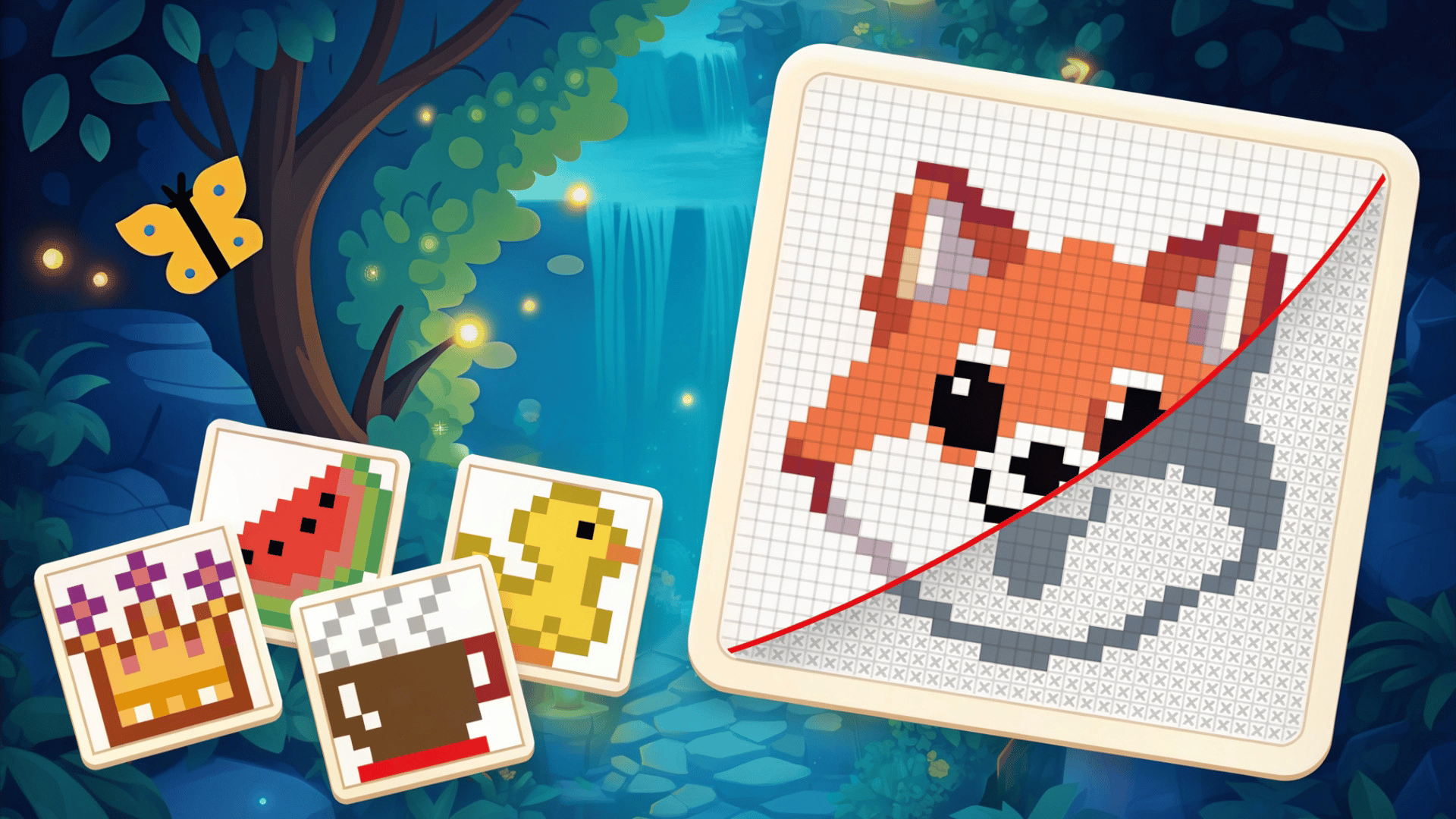
After loading, the canvas displayed a forest scene, a fox card, a star counter, a settings button, and an instruction to tap **Play**. The evidence image is taken from that in-engine state, not the illustrated picture on the provider's landing page. It confirms that the current desktop build runs and presents its nonograms as hidden-picture discoveries.
The friendly artwork sets the atmosphere, while the actual logic is numerical. Completing rows and columns should reveal a picture one square at a time.
Clues force deductions, not guesses
A clue equals row length: Fill the entire line immediately. Full-run clues are forced.. A large run nearly fills a row: Deduce the overlap before marking. Large runs create guaranteed shared cells..
How run clues produce forced fills
Numbers beside a row or column describe groups of consecutive filled cells. A single 5 means five adjoining squares. A clue such as 3 and 1 requires a block of three, at least one empty space, then a separate filled square. The order of groups never changes.
Begin with lines whose clues nearly fill the available length. They offer the greatest overlap and therefore the most certain cells. Mark impossible squares with crosses so they are not reconsidered on every pass.
Suppose a ten-cell row contains a clue of seven. Whether the group begins at the left or the right, several center cells must be filled. Mark those guaranteed overlaps first. New information from crossing columns will reveal the remaining edges.
Avoid committing to one of two possible placements without evidence. A wrong filled square can distort several intersecting lines. When no line is obvious, rescan for completed clue totals and place crosses around a finished group.
The supplied controls say to click or tap the grid and switch between square and cross tools at the bottom. Use filled squares for confirmed picture cells and crosses for cells known to be empty. Keeping both types current reduces repeated counting.
The game supports horizontal and vertical orientations according to its metadata. The forest entry screen used a wide view, but grid readability on a phone was not tested. Small clue numbers may benefit from a larger display or browser zoom that does not disrupt touch alignment.
Scan all rows once, then all columns. Mark only certainties. After each pass, revisit lines intersecting newly filled cells. Count completed groups from an edge and close them with crosses when their required length has been reached.
If the game reports a mistake immediately, decide whether to keep that feedback enabled. Some players prefer error-free deduction without penalties, while others learn faster from confirmation. Settings were visible but not opened during this session.
This is suitable for players who enjoy picross, numerical deduction, and the reward of revealing an illustration. The woodland theme gives progression a light adventure frame without replacing the grid logic. It may be a poor fit for visitors who dislike counting or need large-text clues.
Although the art is friendly, the checked screen did not advertise the service specifically to children. It contained no adult subject, graphic harm, staking, or monetary reward.
A star total appeared on the entry screen, but its use was not explored. A commercial screen also preceded the canvas. Any later reward prompt or content change belongs to the external build.
The first grid was not completed, so error penalties, hint limits, picture sizes, and star spending remain unknown. A future session should solve several puzzles and test both marking modes. Today the evidence supports a working hidden-picture title, an in-game Play prompt, and conventional square-and-cross controls without claiming a completed campaign.
Crosses protect deductions from false fills
Numerical clues describe runs of filled squares.
Marking tools include crosses and squares.
The listing does not document error handling or hints.
Solve full and near-full lines first.
- Solve full and near-full lines first.
- Mark confirmed empties with crosses.
- Cross-reference completed rows and columns.
- Never fill a cell without a line-based reason.
A clue equals row length
A clue equals row length
Fill the entire line immediately.
Full-run clues are forced.
A large run nearly fills a row
Deduce the overlap before marking.
Large runs create guaranteed shared cells.
Mark confirmed empties with crosses.
- Solve full and near-full lines first.
- Mark confirmed empties with crosses.
- Cross-reference completed rows and columns.
Perfect for patient logic solvers.
Perfect for patient logic solvers.
Avoid if you prefer visual guessing.
Grid Odyssey: Nonograms versus connect puzzle image
Grid Odyssey turns numeric run clues into deduction; crosses and squares mark confirmed states. Connect Puzzle Image depends on visual placement and alignment, with no clue system in its checked description.
Read the comparison overview →A classic nonogram deduction workout.
A classic nonogram deduction workout.
Editorial synthesis: Clues force deductions, not guesses
Nonogram value comes from deductions that are forced by the clues, not from guessing a plausible picture. The article emphasizes line intersection, confirmed runs, and contradiction checks so the reader can understand why a cell is safe to mark. This gives the page a clear educational purpose and keeps the recommendation tied to reasoning style. It also sets an honest boundary: the method explains how to read the puzzle family, while the source record does not prove the size, save behavior, or accessibility of every later grid.