Route by box replacement capacity, not color proximity.
Should this screw wait for the box to cycle?
This constructed queue separates matching, remaining holes, and the listed intermediary; it is not a captured board.
When the matching box has one hole left, the safer model is to consider the intermediary rather than force a bad slot.
First bad decision
Force the matching screw into the last remaining hole without considering box replacement.
- Tempting move
- Force the matching screw into the last remaining hole without considering box replacement.
- Why it appeals
- Color matching is the most direct rule.
- Actual cost
- Capacity may make the intermediary or wait state the better route.
Before the next decision
Screw Match: the four-point re-check
- Check remaining holes before color.
- Track the intermediary option.
- Ask whether the next replacement changes capacity.
- Keep one screw decision unresolved until capacity is clear.
Screw Match’s opening screen
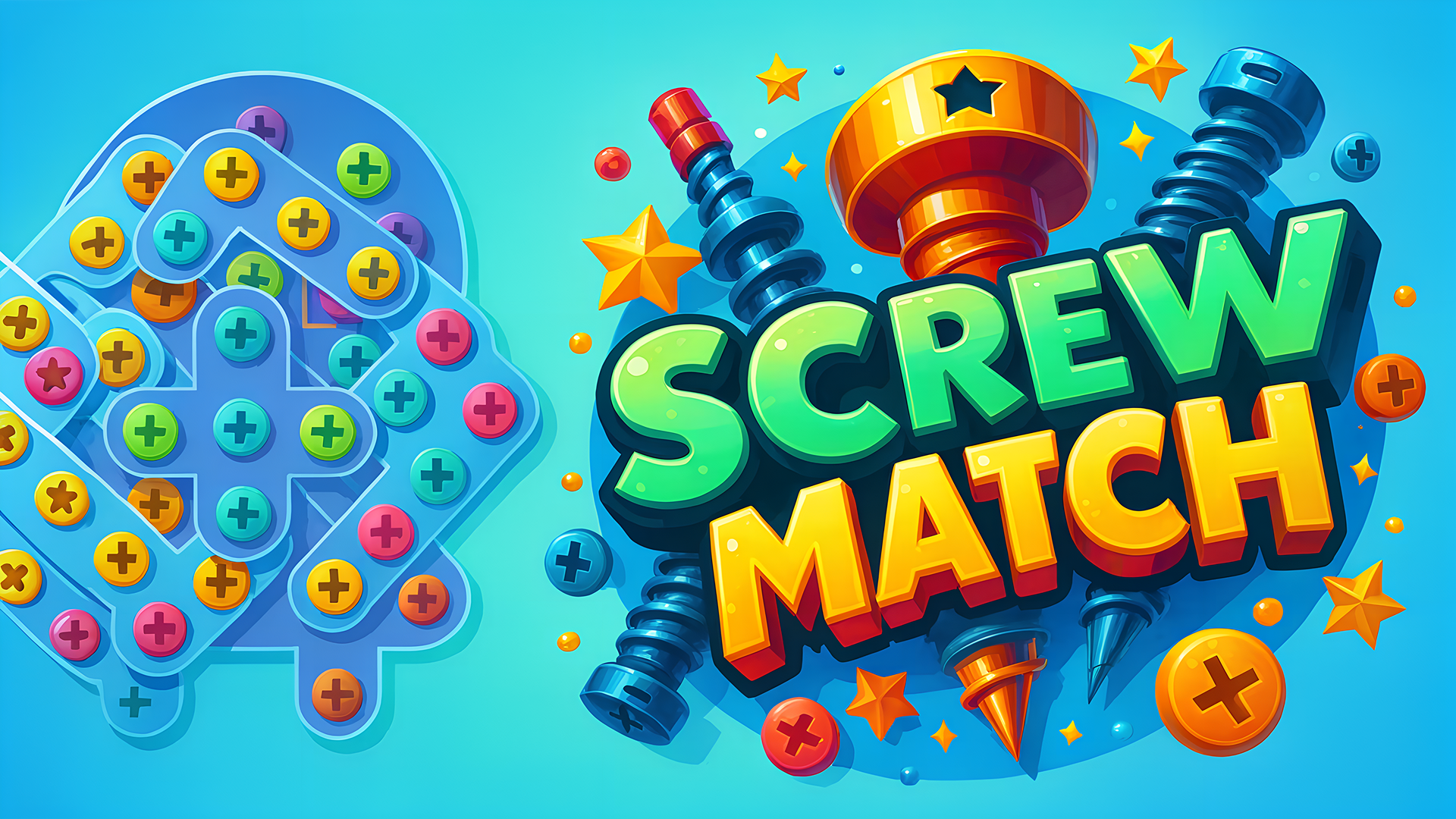
After the source advertisement and its close-confirmation dialog were dismissed, the game opened to a bright blue menu. The Screw Match logo sits above a timed daily challenge and a large Level 1 button. A 100-coin balance, settings control, gift icon, and chest are also visible. Some menu labels appeared in Chinese during our session even though the title logo is English, so localization may depend on the source build or browser environment.
This was a useful inspection because it exposed both the game entry point and the commercial-style reward layer before any puzzle move. We did not claim the daily gift or watch an optional reward ad.
Color routing depends on box capacity
Place colored screws into a matching top box.
A box is replaced when its nut holes are full.
The listing gives the core rule but few level details.
How box capacity routes colors
The theme is mechanical, but the decisions resemble color sorting. Colored screws must be removed from a layered object and directed toward compatible containers. A screw can be available visually while still being a poor first choice if its destination is not ready or if removing it leaves other colors awkwardly ordered.
The level structure appears to reward sequencing. Instead of tapping every exposed screw, the player needs to read the color demand, choose a removable piece, and avoid filling temporary storage with colors that cannot yet be completed. The satisfaction comes from watching a complicated assembly become simpler one deliberate removal at a time.
Before selecting anything, identify the active destination colors. Then scan the outermost screws and group them mentally into ready matches, near matches, and pieces that should wait. A ready match advances a container immediately. A near match is useful only if enough buffer space remains. A waiting piece may be exposed but connected to no short-term plan.
If the board provides temporary holes or storage, reserve at least one for correcting a mistaken order. Filling every buffer with unrelated colors removes the flexibility that the puzzle is testing.
The tested screen filled a 16:9 browser viewport, with the menu concentrated in the center. Large buttons make pointer and touch input straightforward. The game did not expose a readable keyboard-control guide on the first screen, so keyboard support remains unverified. Sound, language, and other preferences may be available behind the gear icon, but we did not change them.
Because one important label was localized differently from the title, readers should rely on icons and the live tutorial as well as this summary. The first level button was visually clear even without translating every surrounding reward label.
The Playgama export showed a full-size advertisement before the game. Attempting to close it produced a second dialog warning that a reward would be lost. Only after confirming close did the actual menu appear. This article records that provider behavior from direct research; it does not embed the runtime or place znvrgames advertising around it.
The menu also contains timers, coins, gifts, and a chest. These mechanics may be harmless progression systems, but they can create pressure for younger players. We did not test purchases, data collection, later difficulty, or the frequency of interstitials.
Screw Match is a plausible fit for players who like tidy transformation puzzles, color grouping, and levels that can be solved by correcting an order. It is a weaker fit for people who dislike reward timers, mixed-language interfaces, or source advertising. The best early test is simple: play one level and notice whether planning the screw order feels satisfying or merely restrictive.
Playgama provides and hosts the executable build; znvrgames does not embed it in this article. znvrgames contributes this independently written observation and does not represent the developer. The live check occurred on August 31, 2026. Provider behavior may change, and our internal full-screen screenshot records only the reviewed starting state.
Replacement timing creates a routing cap
A matching box has space: Route the screw there immediately. Capacity confirms the move.. Matching box is full: Wait for replacement or use the available intermediary glass nut. Forcing a full box is not a legal plan..
A matching box has space
A matching box has space
Route the screw there immediately.
Capacity confirms the move.
Matching box is full
Wait for replacement or use the available intermediary glass nut.
Forcing a full box is not a legal plan.
Check capacity before color.
- Check capacity before color.
- Group same-color screws where allowed.
- Track which boxes are near replacement.
- Avoid moves that hide a needed color.
Group same-color screws where allowed.
- Check capacity before color.
- Group same-color screws where allowed.
- Track which boxes are near replacement.
Good for short color-and-capacity sorting.
Good for short color-and-capacity sorting.
Too thin if you need deeper systems.
Screw Match versus nuts bolts sort
Screw Match routes colored screws into matching boxes and replaces a box when its nut holes are full. Nuts Bolts Sort explicitly moves a top bolt nut to a same-color bolt with available space.
Read the comparison overview →A compact screw-routing puzzle with capacity discipline.
A compact screw-routing puzzle with capacity discipline.
Editorial synthesis: Color routing depends on box capacity
Screw Match combines color routing with box capacity. A correct color choice can still fail if the destination box is full or if removing a screw exposes a route that cannot be used. The article teaches readers to track both the next match and the remaining container room. That dual constraint is the page's independent value: it explains why a visually obvious match may be strategically premature and gives readers a concrete way to compare it with simpler sorting games.