Judge the shot by the wall it opens, not only the color match.
Which angle creates the better follow-up path?
This constructed aiming model compares two legal targets; it does not measure engine physics.
| Shot | Immediate result | Post-shot gap | Risk |
|---|---|---|---|
| Direct match | Removes target cluster | Opens a center lane | May expose a wide row |
| Bank match | Removes side cluster | Keeps center support | Harder to repeat under pressure |
The better shot preserves the next angle, even when a direct match finishes faster.
First bad decision
Take a direct match that removes support from a wide upper row.
- Tempting move
- Take a direct match that removes support from a wide upper row.
- Why it appeals
- It is the shortest legal path.
- Actual cost
- The exposed row may become harder to reach than the saved cluster.
Before the next decision
Bubble Tower: the four-point re-check
- Identify two legal angles.
- Ask what each shot uncovers.
- Prefer the angle that preserves future bank options.
- Adjust after observing the current game’s response.
Bubble Tower’s opening screen
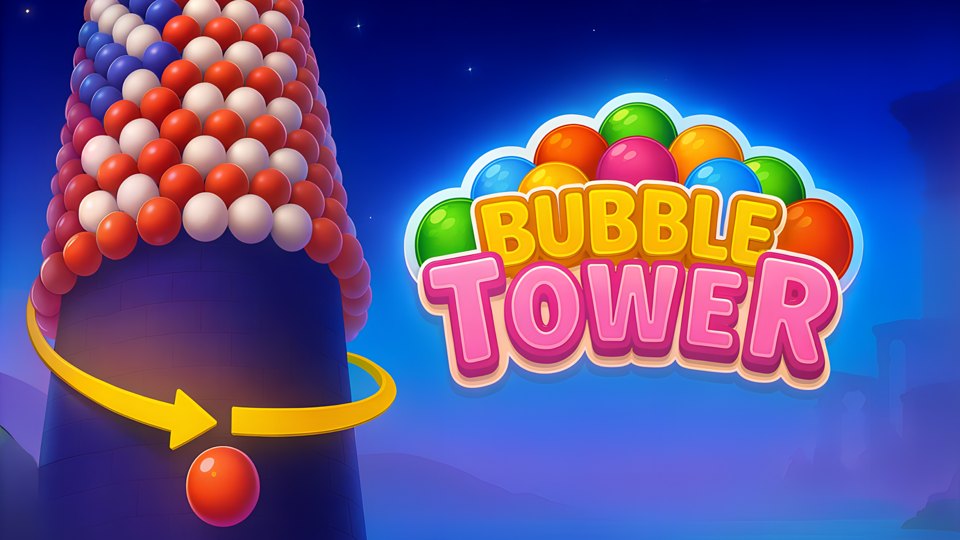
Level 1 loaded with a brick-like vertical tower, a colored bubble launcher, heart and coin counters, and the opening cluster to clear. Unlike a flat bubble-shooter board, targets wrap around a cylindrical structure. The evidence image records that playable starting state at 1280 by 720 after the external loading message was closed.
The tower shape changes the basic matching problem. A cluster can sit partly out of sight, so aiming depends on rotation and line of sight as well as color. A shot that looks isolated from one angle may connect after the structure turns.
Rotation reveals the true target
The source describes rotating a cylindrical tower, aiming at matching bubbles, and firing to clear groups.
The listed controls distinguish dragging to rotate, dragging to aim, and release or tap to fire. The description mentions tighter shot limits later, but no complete level-by-level budget is verified.
How rotation exposes the useful cluster
The instructions describe aiming a colored bubble and joining it to at least two bubbles of the same color. A group of three or more then pops. Pieces no longer connected to the main structure can fall, making support points more valuable than small surface matches.
Before firing, look beyond the immediate group. If removing one color detaches several lower bubbles, that route creates more progress than a match at the outer edge. Diamonds or other goals may appear within the structure, so some levels can favor exposing an object rather than clearing every visible piece.
Rotate slowly enough to remember where useful clusters are positioned. Pick a reference feature on the tower, such as a large color group or a gap, and return to it after scouting the far side. Constant spinning makes it easy to lose track of the next bubble in the launcher.
When two targets are equally safe, choose the one that opens a larger angle for the following shot. Narrow gaps can close as new bubbles attach. A strong move improves both the current match and the path available to the next color.
The published controls use dragging or tapping to rotate, aim, and release. On desktop, small pointer adjustments help when firing around an edge. The vertical playfield fits a phone naturally, but fingers may obscure the launcher and lower target area.
No keyboard mapping appeared in the inspected state. Hearts and coins were visible, but their behavior was not activated. Players should watch the loaded prompts because the exact gesture for rotating the tower may differ from the gesture for aiming a shot.
First, rotate once around the tower without firing. Count the largest same-color groups and find any bubbles supporting pieces below them. Return to the launcher, compare its current color with those groups, and select the shot with a clean path.
Avoid squeezing bubbles into single-width gaps unless they immediately complete a match. If the next-bubble preview is visible, use it to decide whether to build a pair or clear an existing group. Preserve broad shooting lanes near the lower half of the structure.
This works for visitors who enjoy bubble matching but want a spatial variation on the flat format. It combines quick aiming with a small amount of planning and provides a clear level boundary. It may frustrate players who prefer static boards, dislike limited-life systems, or need every target visible at once.
The captured stage showed colorful abstract pieces and no realistic violence, adult theme, gambling-styled mechanic, or cash reward. The heart symbol appears to represent attempts or health within the puzzle.
Playgama supplied the pre-load advertising, and later prompts may change by session. We did not run out of shots, lose a heart, spend coins, collect a diamond, or clear Level 1. The number of levels and refill timing are unknown.
Further testing should measure shot limits, verify how unsupported bubbles fall, and determine whether reward viewing is optional. The current description remains grounded in the visible first tower and the stated match rule rather than suggesting complete knowledge of the progression system.
Because the target wraps around a cylinder, rotation can be used as a scouting action rather than a last-second correction. Inspect both edges of the visible cluster before committing the next bubble, look for same-color groups hidden around the curve, and choose an angle that leaves the following launcher color with a route. A match near the base of a large attached section may be more valuable than a simple trio near the top if unsupported pieces actually fall.
The heart and coin counters should be observed separately from the shot rule. Losing a life, paying for a retry, and buying a helper are different systems, and the opening screen does not show which applies. A future run should intentionally miss once, complete one match, and rotate through a full turn without shooting. Recording those responses would clarify whether rotation is free, how aim prediction works at the rear edge, and whether a player can plan rather than fire blindly.
Use rotation to reveal the support behind a cluster
Imagine two visible blue bubbles at the front and a third blue around the tower’s far side. A red cluster partly hides the connection between them.
Rotate before spending a shot so you can judge whether a blue shot can actually join the group. Two bubbles that seem adjacent from one camera angle may occupy different sides of the cylinder. Inspection is valuable because it changes the information available without assuming that a shot has been fired. Do not infer an automatic whole-cluster drop from the image alone; support and removal rules must be checked separately.
The arrangement is constructed. No exact match threshold, free-rotation allowance, or drop outcome is asserted for a level.
A group appears on the near side
A group appears on the near side
Check whether rotation exposes a better match.
First visibility is not necessarily best value.
A cluster spans angles
Plan a sequence, not a single turn.
Rotation can separate a useful arrangement.
Good for observational matching with a spatial twist.
Good for observational matching with a spatial twist.
Poor fit if repeated rotation causes discomfort.
Scan several angles before acting.
- Scan several angles before acting.
- Track groups that reappear from behind.
- Rotate slowly enough to preserve orientation.
- Choose matches that improve the next view.
Track groups that reappear from behind.
- Scan several angles before acting.
- Track groups that reappear from behind.
- Rotate slowly enough to preserve orientation.
Bubble Tower versus tile match
Tile Match describes an urgent downward border. Bubble Tower describes selecting a view before an aimed shot. Both involve matching, but only the first source establishes continuous downward pressure.
Read the comparison overview →A distinctive rotate-and-read puzzle; test comfort early.
A distinctive rotate-and-read puzzle; test comfort early.
Editorial synthesis: Use rotation to reveal the support behind a cluster
Bubble Tower rewards reading support, not just color. Rotating or removing a visible cluster can expose the piece carrying the next layer, so the safest move is often the one that preserves the tower's remaining support while opening a route. The page turns this into a stability question: after the move, what is still holding the structure together? That helps readers distinguish a physics-leaning placement puzzle from a straightforward match game and gives them a concrete reason to value controlled experimentation.